
Anklebot-Assisted Rehabilitation for Stroke Patients Playing Targeting Video Game
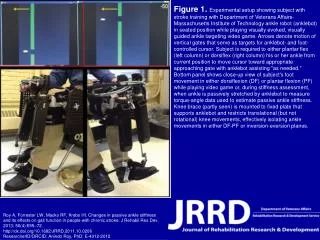
This experimental setup demonstrates stroke rehabilitation using an ankle robot (Anklebot) developed by the Department of Veterans Affairs and the Massachusetts Institute of Technology. In a seated position, subjects engage in a visually guided video game that requires ankle movements to control a foot cursor toward dynamic targets. The setup allows for the assessment of ankle stiffness through passive stretching while isolating movements. This research aims to understand the effects of passive ankle stiffness on gait function in chronic stroke survivors.

Anklebot-Assisted Rehabilitation for Stroke Patients Playing Targeting Video Game
E N D
Presentation Transcript
Figure 1. Experimental setup showing subject with stroke training with Department of Veterans Affairs-Massachusetts Institute of Technology ankle robot (anklebot) in seated position while playing visually evoked, visually guided ankle targeting video game. Arrows denote motion of vertical gates that serve as targets for anklebot- and foot-controlled cursor. Subject is required to either plantar flex (left column) or dorsiflex (right column) his or her ankle from current position to move cursor toward appropriate approaching gate with anklebot assisting "as needed." Bottom panel shows close-up view of subject's foot movement in either dorsiflexion (DF) or plantar flexion (PF) while playing video game or, during stiffness assessment, when ankle is passively stretched by anklebot to measure torque-angle data used to estimate passive ankle stiffness. Knee brace (partly seen) is mounted to fixed plate that supports anklebot and restricts translational (but not rotational) knee movements, effectively isolating ankle movements in either DF-PF or inversion-eversion planes. Roy A, Forrester LW, Macko RF, Krebs HI. Changes in passive ankle stiffness and its effects on gait function in people with chronic stroke. J Rehabil Res Dev. 2013; 50(4):555–72.http://dx.doi.org/10.1682/JRRD.2011.10.0206 ResearcherID/ORCID: Anindo Roy, PhD: E-4312-2012