
Uploaded by
kaida
0 SLIDES
287 VIEWS
0LIKES
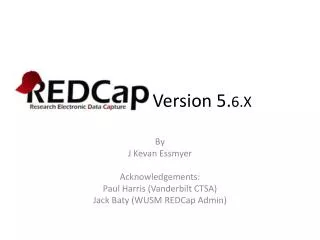
Managing Clinical Data Using REDCap
DESCRIPTION
Managing Clinical Data Using REDCap . Peter E. Gabriel, MD Andrew J Cucchiara, PhD October 11, 2012. The Research Database Problem. The 27-version Excel spreadsheet… The Access database created by the summer intern… Paper surveys… Hard drive crashes… The statistician’s blues…
Download

1 / 0
Download Presentation 
Managing Clinical Data Using REDCap
An Image/Link below is provided (as is) to download presentation
Download Policy: Content on the Website is provided to you AS IS for your information and personal use and may not be sold / licensed / shared on other websites without getting consent from its author.
Content is provided to you AS IS for your information and personal use only.
Download presentation by click this link.
While downloading, if for some reason you are not able to download a presentation, the publisher may have deleted the file from their server.
During download, if you can't get a presentation, the file might be deleted by the publisher.
E N D
Presentation Transcript
-
Managing Clinical Data Using REDCap
Peter E. Gabriel, MD Andrew J Cucchiara, PhD October 11, 2012 - The Research Database Problem The 27-version Excel spreadsheet… The Access database created by the summer intern… Paper surveys… Hard drive crashes… The statistician’s blues… Sharing data outside Penn… Security? Privacy? Audit trails? Oh my!
- The REDCap Solution Research Electronic Data Capture Web-based, user-friendly database system, originally developed at Vanderbilt University Now overseen by the REDCap Consortium: 473 institutional partners in 48 countries Supports concurrent access by multiple users from anywhere via web browser Robust data integrity, nightly backups, etc. Excellent security and privacy features, with extensive audit logging HIPAA-compliant, 21 CFR Part 11 capable Easy to export data to Excel and statistical packages Supports surveys, ad-hoc reporting, event scheduling, file sharing, auto- data validation, branching logic, calculated fields, and more
- Accessing REDCap UPHS: https://redcap.med.upenn.edu CHOP: https://redcap.research.chop.edu
- Agenda Creating and Managing Projects Building Data Collection Forms Entering Data Controlling User Access Rights Ad Hoc Reports and Exporting Data (Advanced Tools)
- Creating a New Project Enter Project Title:
- Select a Project Purpose Only used to track usage statistics – does not affect functionality
- Select a Project Type & Collection Format Key Question: Is REDCap right for your project?
- REDCap Project Types Single Survey Ideal for collecting anonymous, one-time responses from participants – similar to a basic SurveyMonkey survey Participants are emailed a link that points to a web form in order to collect responses; they do not need to have a REDCap account Data Entry Forms Intended for data capture by clinicians with a REDCap account Single Survey + Data Entry Forms Can be used to initially populate records with participant responses in order to initiate data collection (example: pre-screening survey)
- Data Entry Collection Format Classic Data Collection Data to be collected once per subject – i.e. one “record” per subject Longitudinal/Repeating Collection Data collected multiple times per subject Fixed number of collection points that correspond to pre-defined events, e.g. Initial Evaluation, 3mo. follow-up, 6mo. follow-up, 1yr follow-up Optional scheduling via project calendar
- A Brief Word on Data Relationships One-to-many and many-to-many relationships are common in healthcare data E.g. one patient can have many diagnoses, procedures, medications, lab results, etc. Data sets containing these complex relationships may need to be restructured in order to work with REDCap Example: This will not work in REDCap as structured.
- Options for Restructuring Data Convert multi-valued data fields into a series of “yes/no” fields Example: Aspirin Yes/No? Beta blocker Yes/No? Summarize your longitudinal data points into aggregate statistics over a fixed time period and use “Classic” collection format Example: Min Hgb A1c, Max Hgb A1c, etc. Align your longitudinal data points with pre-defined events and use “Longitudinal” collection format Example: Pre-Treatment PSA, 6-month post-treatment PSA
- Restructuring Data - Examples Complex data with many-to-many relationships… …restructured to be “flat:”
- Restructuring Data - Examples Complex data with many-to-many relationships… …restructured to be “event-based:”
- Creating a New Project Enter Project Title:
- Project Setup Navigation Pane Center Work Area
- Project Setup These buttons are only a “to-do list” for your benefit – they do not control project functionality
- Project Setup We just did this when we created the project – click here if you need to go back and change the format again
- Project Setup Advanced settings – more on these later
- Project Setup Copying, archiving, and deleting a project
- Project Setup Best way to get started building forms
- Data Collection Instruments An instrument is a single data entry form A subject has exactly one record across all data entry forms – i.e. all the data fields eventually combine into one big row per subject in the exported data
- Data Collection Instruments (cont.) So why have more than one instrument? Logical grouping of related data fields Can control user access at the instrument level – e.g. a data entry assistant can be restricted from seeing the demographics form that contains PHI
- REDCap Shared Library The REDCap Shared Library can be a good source for standardized instruments, e.g. CDASH, SF-36, FACT-G, etc. Content will hopefully grow over time
- Data Collection Instruments Click instrument name link to: Modify an existing form Add additional fields to form Modify existing questions Change attributes of questions
- Online Designer Data Fields Add New Field Section Header Preview Button
- Data Field Operations
- A Note on the Study ID Field The first data field in every project is the unique record identifier for that project Default variable name is “study_id” but you can rename it to something else Can be a “real” ID like MRN or SSN, or a randomly-assigned number. Must be unique. Can set it to be auto-assigned by REDCap (Project Setup Make customizations Use auto-numbering for naming new project records)
- Creating / Editing a Data Field
- Field Types
- Defining the Field Attributes Variable Name Unique data column name Validation Data type/format constraints Required Mandatory field Identifier Mark as an identifier (PHI) Custom Alignment Question arrangement Field Note Additional instruction for data entry person
- Variable Name Requirements Should be descriptive (i.e. not cryptic as with a1, xyz, lol). The variable name is how analysis data is referenced. The first character of a variable name must be an alphabetical character (i.e., A to Z or a to z). All other characters of a variable name may contain alphabetical characters, numbers 0 to 9 or underscores (i.e., spaces, punctuation marks, mathematical functions, special characters and symbols are NOT allowed). Length of variable names should contain fewer than 26 characters; shorter variable lengths are better to reduce the risk of truncation by statistical analysis packages. Variable names must be unique among all instruments (i.e. forms) within a specific REDCap Project.
- Text Field Validation Verifies data input to prevent invalid entry, prior to form submission
- Required Fields Required fields are labeled with *must provide value Warning prompt when trying to save: Not a “hard stop” - possible to override
- “Identifier” Fields Fields that constitute protected health information (PHI) can be marked as an “Identifier.” These fields can then be excluded on data export, allowing for analysis of “de-identified” data Users can also be restricted in their ability to export Identifier fields based on access rights
- Custom Alignment Examples Custom Alignment controls the position and orientation of the responses on data entry forms.
- Permissible Values for Multiple Choice Fields A value (1 to n) is automatically assigned to each choice when the field is saved: Can also manually code values yourself by entering ‘# , text description’
- Creating a Conditional Field Branching logic can be used to show fields that meet a certain condition
- Creating a Conditional Field (cont.) Specify the variable and value of the field that makes the condition true Complex AND / OR / NOT logic is possible is possible with the “Advanced Branching Logic Syntax” (vs. the “Drag-N-Drop Logic Builder”)
- Creating a Conditional Field (cont.) The field containing branching logic will show/hide based on the value of the field(s) it depends on
- Agenda Creating and Managing Projects Building Data Collection Forms Entering Data Controlling User Access Rights Ad Hoc Reports and Exporting Data (Advanced Tools)
- Starting Data Collection The Data Collection area of the navigation pane, lists all the forms (aka instruments) available for the project In order to create a new record, the form that contains the Study ID must be entered first.
- Creating a New Study ID A new record is created whenever a non-existing identifier is entered on the first page of the data collection interface. If the record already exists then the record for that Study ID is retrieved. 1234567
- Using an Existing Study ID An existing Study ID can also be selected from the appropriate dropdown list on the first page of the data collection interface.
- Form Status All collection forms (aka instruments) have a “Form Status” field at the end of the form There are three possible record statuses: Incomplete Unverified Complete “Save Record” saves and exits the record “Save and Continue” saves and opens the next collection form if there is one, or saves and keeps the current record open if not
- Viewing the Edit History To view the edit history for a particular field, click the “H” icon next to the field:
- User Rights and Permissions Allows you to grant a user full or partial access to the project
- Granting User Privileges Basic user rights include access to various modules and ability to export PHI
- Granting User Privileges Ability to lock a particular record from further editing Ability to Create / Rename / Delete project records Data Entry Rights are specified individually for each data collection form
- Data Access Groups Data Access Groups is an advanced feature useful for multi-center trials and collaborations Users in a particular Data Access Group can only see records entered by other users in that Data Access Group
- Ad-Hoc Reporting “Report Builder” allows you to run simple queries within REDCap
- Ad-Hoc Reporting (cont.) “Graphical Data View & Stats” provides some simple statistics for every field in a particular data collection instrument
- Data Export Simple Data Export can be used to export an entire project data set Advanced Data Export allows you to select specific fields and de-identify the data set if desired
- Data Export – De-Identification Options
- Data Export – Available Formats Can export to comma-separated values (.csv) format and a variety of statistical package formats For Excel export, “Raw” option includes variable names as column headers; “Labels” includes descriptive field names
- Advanced Features Customizing project settings Creating and managing forms and data fields using the downloadable “data dictionary” Importing data Data Quality module File Repository Event Log
- Resources Beyond This Course redcap@mail.med.upenn.edu Andy Cucchiara (andy@upenn.edu, 215-662-2293) Pete Gabriel (peter.gabriel@uphs.upenn.edu, 215-615-3437) Join CHOP/UPenn REDCap Users’ Group Meetings Usually first Wednesday each month Physically attend at 3535 Market St Virtually attend via ‘GoToMeeting’ REDCap Help & FAQ, Training Resources:












More Related