
Enhanced Design Environment for Industrial Casting Processes using Parallel Computing
This project, part of the EU ESPRIT program (Reference: ESPRIT 28144), ran from September 1998 to February 2001, focusing on modeling the mould filling processes in industrial casting. The primary objectives included determining the position of the molten metal front, predicting conflicting regions, computing filling times, and accounting for thermal effects. Key methodologies utilized were level set techniques for tracking free surfaces, stabilized finite element approximations of the incompressible Navier-Stokes equations, and block-iterative coupling with temperature.

Enhanced Design Environment for Industrial Casting Processes using Parallel Computing
E N D
Presentation Transcript
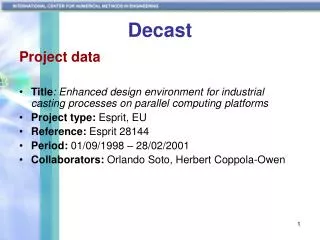
Decast Project data • Title: Enhanced design environment for industrial casting processes on parallel computing platforms • Project type: Esprit, EU • Reference: Esprit 28144 • Period: 01/09/1998 – 28/02/2001 • Collaborators: Orlando Soto, Herbert Coppola-Owen
Objectives To model mould filling processes: • To determine the position of the front of the molten metal • To predict conflicting regions • To compute filling times • To account for thermal effects
Key numerical ingredients • Tracking of free surfaces through level set techniques • Stabilized finite element approximation of the incompressible Navier-Stokes equations • Block-iterative coupling with temperature