Normalization 2
This guide explores the critical concepts of database normalization, including functional dependencies and the various normal forms (1NF, 2NF, 3NF, BCNF, and more). It explains how data is structured to eliminate redundancy and ensure data integrity through the process of normalization. The relationship between attributes, creating functional dependencies, and how they impact the design of relational databases are also discussed. Examples illustrate these principles in practice, providing a clear understanding of the normalization process vital for effective database design.


Normalization 2
E N D
Presentation Transcript
Normalization 2 Todd Bacastow IST 210
Normalization • Methods • Inspection • Closure • Functional dependencies are key
Normal Forms Universe of relations 1 NF 2NF 3NF BCNF 4NF 5NF
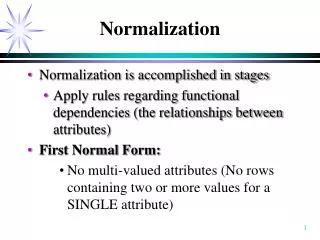
First Normal Form (1NF) • All appropriate data into the empty columns of rows containing the repeating data (‘flattening’ the table), ie, no repeating items in columns
Second Normal Form (2NF) • In 1NF and every non-key column is fully dependent on the (entire) primary key
Third Normal Form (3NF) • In 2NF, every non-key column is mutually independent, ie, no transitive dependencies
Functional Dependencies • Describes the relationship between attributes in a relation • Example • If A and B are attributes of relation R, A functionally determines B (A B), if each value of A is associated with exactly one value of B. A B A functionally determines B
Functional Dependencies • Functional dependencies arise from the nature of the real world that the database models. • Often A and B are facts about an entity where A might be some identifier for the entity and B some characteristic. • Functional dependencies cannot be automatically determined by studying one or more instances of a database. • They can be determined only by a careful study of the real world and a clear understanding of what each attribute means.
Functional Dependencies • Important as a constraint on the data that may appear within a relation • Scheme-level control of data • Mathematical tool for explaining the process of “normalization” ---- vital for DB redesigning
Example Drinkers (name, addr, beersLiked, manf, favoriteBeer) • Reasonable FD’s to assert: • name addr • name favoriteBeer • beersLiked manf • Note: these happen to imply the underlined key, but the FD’s give more detail than the mere assertion of a key
Example (cont.) • Key (in general) functionally determines all attributes. • name beersLiked addr favoriteBeer beerManf • Shorthand: combine FD’s with common left side by concatenating their right sides • When FD’s are not of the form (Key) other attribute(s), then there is typically an attempt to “cram” too much into one relation. • Sometimes, several attributes jointly determines another attribute, although neither does by itself. • Example: beer bar price
Formal Notion of Key • K is a key for relation R if: (1) K all attributes of R(K functionally determines all the attributes of R) (2) For no proper subset of K is (1) true • If K at least satisfies (1), then K is a superkey
Example Drinkers (name, addr, beersLiked, manf, favoriteBeer) • {name,beerLiked} FD’s all attributes, as seen • Shows {name,beerLiked} is a superkey (functionally determines all attributes) • name beersLiked is false, so name not a superkey • beersLiked name also false, so beersLiked not a superkey • Thus, {name,beersLiked} is a key • No other keys in this example • Neither name nor beersLiked is on the right of any observed FD, so they must be part of any superkey
Who determines Keys/FD’s • We could define a relation schema by simply giving a single key K • Then the only FD’s asserted are that KA for every attribute A • No surprise: K is then the only key for those FD’s, according to the formal definition of ‘Key.’ • Or, we could assert some FD’s and deduce one or more keys by the formal definition • E/R diagram implies FD’s by key declarations and many-to-one relationship declarations
Rule of thumb • FD’s either come from keyness (i.e., a set of attributes that functionally determines all attributes), many-to-one relationship, or from physics • E.g., “no two courses can meet in the same room at the same time” (at least we don’t know a way) yields room time course
AB A AB functionally determines B Boyce-Codd Normal Form • Goal = Boyce-Codd Normal Form • BCNF = all FD’s follow from the fact keyeverything • Formally, R is in BCNF if every nontrivial FD for R, say XA, has X a superkey (i.e., X functionally determines all attributes). • Why important? • Guarantees no redundancy due to FD’s • Guarantees no update anomalies • Guarantees no deletion anomalies Trivial dependency - A dependency is trivial if the functionally determined attribute is a subset of the functionally determining attributes. For instance,
Using Closure to Reach BCNF • The closure of a set F of functional dependencies is the set of all functional dependencies logically implied by F. • Setting: relation R, given FD’s F. Suppose relation R has BCNF violation XB. • We need only look among FD’s of F for a BCNF violation. • Compute X+ (cannot be all attributes) • Decompose R into X+ and (R-X+) X. • Find the FD’s for the decomposed relations R X+ X
Example Drinkers (name, addr, beersLiked, manf, favoriteBeer) • FD’s: • name addr • name favoriteBeer • beersLiked manf • Pick BCNF violation name addr • Close the left side: name+ = name addr favoriteBeer • Decomposed relations: Drinkers1(name,addr,favoriteBeer) Drinkers2(name,beersLiked,manf) • New FD’s: For Drinker1: nameaddr and namefavoriteBeer (BCNF) For Drinker2: beersLikedmanf (violates BCNF, decompose again)
Example (cont.) • Final relations all in BCNF Drinker1(name,addr,favoriteBeer) Drinker3(beersLiked,manf) Drinker4(name,beersLiked)