Download

1 / 12
130 likes | 245 Views
This comprehensive guide explores the concept of static charges, detailing how we can identify charged objects using electroscopes. Discover how metal-leaf electroscopes work, observing the behavior of leaves when influenced by nearby charged objects. Learn about charging methods, including contact and induction, and how neutral objects can become charged either by touching a charged object or through proximity. The guide highlights grounding, a technique to maintain a permanent charge, ensuring you grasp the fundamental principles of electrostatics.

E N D
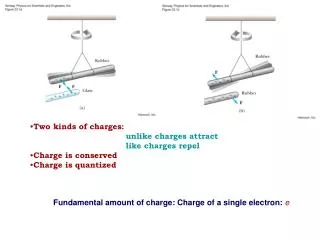
How do we know when an object is charged? • Other than testing whether or not it sticks to something else?
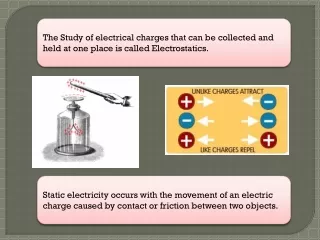
Electroscopes (detect static charge) • Metal-leaf electroscope • “Leaves” suspended from metal rod • Neutral: charges spread out over the whole structure
Electroscopes • When a negative rod is brought near a neutral electroscope, the electrons move down into the leaves • Leaves are now both negative, so they repel each other (move apart) • Study of static charges = electrostatics
Charging by Contact Negative Object: • You can charge a neutral object by contact when you touch it with a charged object. • The object becomes TEMPORARILY charged.
Charging by Contact Positive Object: • The neutral object will end up with the same charge as the already charged object.
Charging by Contact Negative Object: Positive Object:
Induction • Neutral object becomes charged when an already charged object is brought NEAR it. E.g. if you first rub a balloon on your hair, electrons transfer from your hair to the balloon, making it negative (charge by friction)
Induction • When you then bring the negative balloon near a neutral wall, the negative electrons on the balloon repel the negative charges on the wall, making the wall’s surface positive. • We say the balloon induces a charge, because it charges it without contacting it
Induction • When you induce a charge in a neutral object, you can then ground the charged object so that it remains PERMANENTLY charged. • Grounding = connecting a charged object to Earth’s surface • When you do this, you provide a path for electrons to travel to or from the ground • This newly charged object will have the opposite charge of the object you charged it with