Structure of the Earth
200 likes | 457 Views
This article explores the Earth's compositional layers and the techniques used to study them. Using echo-sounding methods, such as seismic reflection, scientists can analyze the Earth's crust by capturing seismic waves caused by explosions or thumper trucks. Key seismic wave types, P-waves, and S-waves are detailed, highlighting their characteristics and behaviors through different media. The crust's structure, along with the mantle and core's composition, is explained, showcasing Earth's lithosphere, asthenosphere, and core's distinct roles. We delve into the four spheres of Earth: geosphere, hydrosphere, atmosphere, and biosphere.


Structure of the Earth
E N D
Presentation Transcript
How do we know? • Echo-sounding techniques are used to explore the Earth's crust. Images, similar to sonograms, are produced. A sonogram in the crust is called a seismic reflection. Seismic waves from "small explosions or thumper trucks" return echoes from rock layers. Seismographs pick up these echoes.
How do we know? continued • Seismic measurements from earthquakes • P waves and S waves • P waves are primary waves, they travel faster than S waves, which are secondary waves • P waves are compression waves, exerting a force parallel to the direction of travel • P waves can travel through liquid or solid • S waves are shear waves that exert a force perpendicular to the direction of travel • S waves can only travel through solid media
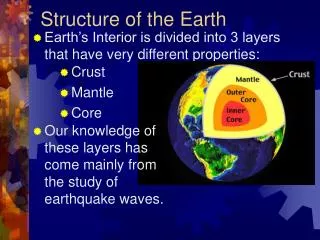
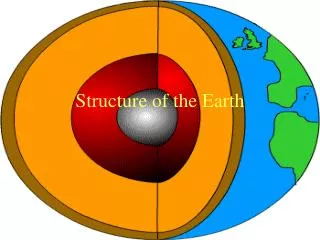
Crust • 5 – 80 km thick • two types: • oceanic - thinner and more dense • 5 – 10 km thick • Continental – thicker and less dense • 15 – 80 km thick • Mostly made up of silicate rock • Comprises only 1% of Earth’s mass
Mohorovicic • Boundary between crust and mantle
Mantle • 2900 km thick • Iron • Comprises 66% of Earth’s mass
Core • Radius of 3500 km • Iron and nickel • Comprises 33% of Earth’s mass
Structural Zones • Lithosphere • Asthenosphere • Mesosphere • Outer core • Inner core
lithosphere • 15 – 300 km thick • Comprised of crust and upper mantle • Brittle, cool portion of Earth • Outermost layer
Asthenosphere • 200 – 250 km thick • Solid, but with ability to flow (plasticity)
Mesosphere • Lower portion of mantle • Extends to 2900 km beneath surface • Solid rock
Outer core • Extends to a depth of 5150 km beneath surface • Dense liquid metal
Inner core • Dense, rigid solid
Earth’s 4 “Spheres” of study • Geosphere • Hydrosphere • Atmosphere • Biosphere