Introduction to International Economic Law: Treaties, Institutions, and Contemporary Issues
This course offers a comprehensive overview of International Economic Law (IEL), its key treaties, and institutions, focusing on the WTO, IMF, and World Bank. Students will explore trade in goods and services, foreign direct investment, and regional economic integration. Engaging discussions and group work will enhance understanding of bilateral and multilateral approaches to economic cooperation. Participants will analyze case studies, prepare for a mock exam, and address pressing issues such as globalization, enforcement, and the role of domestic law in IEL.

Introduction to International Economic Law: Treaties, Institutions, and Contemporary Issues
E N D
Presentation Transcript
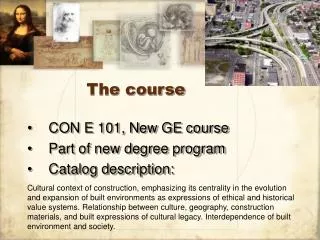
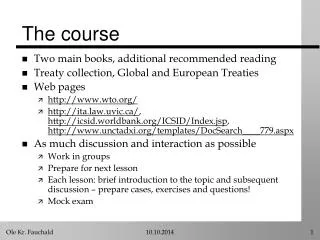
The course • Two main books, additional recommended reading • Treaty collection, Global and European Treaties • Web pages • http://www.wto.org/ • http://ita.law.uvic.ca/, http://icsid.worldbank.org/ICSID/Index.jsp, http://www.unctadxi.org/templates/DocSearch____779.aspx • As much discussion and interaction as possible • Work in groups • Prepare for next lesson • Each lesson: brief introduction to the topic and subsequent discussion – prepare cases, exercises and questions! • Mock exam
The development of IEL • The core of IEL: trade in goods, trade in services, foreign direct investment • Bilateral -> multilateral, 1920-40 • UN: ECOSOC: Bretton Woods and Havana • Five main tracks • IMF and the World Bank (IBRD) • Havana Charter (ITO) -> GATT -> WTO • Regional economic integration • Bilateral investment treaties -> economic co-operation and multilateralism(?) • Bilateral tax treaties -> co-ordination through OECD • Effects of the financial crisis?
The nature of IEL • Bilateral -> multilateral? • Differentiated development • Do we see a set-back of multilateralism? • Contractual -> law-making (constitutional)? • The purpose of IEL: interests of domestic actors -> peace, sustainable development, poverty reduction? • Issues addressed: border measures -> domestic measures • Special treatment of categories of goods and states? • The emergence of ”trade and …” issues: globalization • Institutional development: enforcement and dispute settlement • Participation (Russia) • Progressive development • The ”bicycle hypothesis”
Functions of the WTO • Art. III of the WTO Agreement • Implementation • Negotiations • Settlement of disputes • Trade policy review • Coordinate global economic policy with relevant institutions • + Assistance to developing countries • Rules concerning: • Goods • Services • Investment • Public market intervention • Subsidies • Public procurement • Intellectual property rights • Private market intervention • Dumping • Competition
Basic substantive rules • Non-discrimination • MFN and national treatment • Market access • Border measures (tariffs, import and export restrictions, border control) • ”Unfair trade” • Creating and maintaining a ”level playing field” (subsidies, dumping, public procurement?) • Harmonisation of domestic measures • Trade facilitation (technical barriers to trade, facilitation of procedures, IPR) • ”Trade and …” rules
Sources of law in the WTO • Supremacy of the WTO Agreement (art. XIV:3) • GATT 1947 and GATT 1994 • The supremacy of the other agreements of Annex 1A over GATT – lex specialis (General interpretative note to Annex 1A) • ”Interpretative Notes”, ”Understandings” and footnotes • What is the ”context” for the purpose of agreements under the WTO? • What is ”agreement” and ”subsequent practice” in the context of the WTO? • Relationship to other agreements of international law
Institutions and procedure • Main bodies of the WTO • Ministerial Council • General Council (also working as Dispute Settlement Body) • Councils for goods, services and IPR • Secretary General – ”Green Room meetings” • Decision-making • Tradition of consensus, but majority vote is available (art. IX-X of the WTO Agreement) • Amendments – art. X:1 – rounds of negotiation • Interpretation – art. IX:2 • Waivers – art. IX:4 • Use of ”soft law” • Implementation and dispute settlement • Notifications, Trade Policy Review Mechanism, dispute settlement with possibility of appeal
Membership of the WTO • 153 members • Major country not yet a member: Russia • The EC as a member • How to become a member – accession? • Art. XII of the WTO Agreement • Working Party on Accession • WTO ”acquis” • Algeria 22 years and counting! Russia 16 years • China’s remaining ”market economy” hurdle • Only trade related obstacles? • Observers • Non-members, IGOs and NGOs in the WTO – art. 5
WTO and domestic law • Duty to ensure conformity with the WTO agreements, art. XIV:4 • VCLT art. 27 vs. GATT art. XXIV:12 • The issue ”nullification or impairment of benefits”, GATT art. XXIII • The position of WTO law in domestic law • Depends on domestic law – dualism/monism • For dualist countries: The doctrine of ”treaty-consistent interpretation” • For monist countries: Are provisions under the WTO ”self-executing” (the issue of direct effect)? • Provisions denying self-executing status, e.g. the US • Provisions giving procedural rights to private parties
Financial issues and funding • International Monetary Fund • Stability in international financial markets • Prerequisite for international trade and investment • Taken on broader responsibilities – help to developing countries in financial trouble • World Bank – “IBRD” • Funding of projects • Link to aid agencies and to environmental agreements • The 1965 ICSID Convention (International Centre for the Settlement of Investment Disputes) • World Bank Inspection Panel • Voting rules of the organisations • The role of law in the organisations
International investment law • A tri-partite area of law • Host state • Home state • Investor (+ affected third parties) • Complex legal situation • Treaty obligations and customary international law • Domestic legislation • Investor – state agreements • Investor – investor agreements • Unilateral statements • Grey area • International law / domestic law • Private law / public law
General background • Historic development • Commercial treaties – 1770s (FCN – friendship, commerce and navigation • Bilateral investment treaties – 1950s • Capital export -> economic integration • Regional economic integration agreements and economic cooperation agreements • Multilateral – the Energy Charter Treaty and the Multilateral Agreement on Investment • Institutional setting • “Investment” – broad definition • Establishment vs. investment protection • Dispute settlement – private parties