Download
1 / 3
30 likes | 164 Views
When an astronaut drops a hammer and a feather simultaneously from the same height on the Moon's surface, they indeed hit the ground at the same time. This phenomenon occurs due to the absence of air resistance on the Moon, allowing both objects to accelerate equally under the force of gravity. Understanding this event illustrates key principles of physics, such as gravitational acceleration and the effects of air resistance on falling objects. The tutorial encourages further exploration of terminal velocity in different contexts to deepen your grasp of these concepts.

E N D
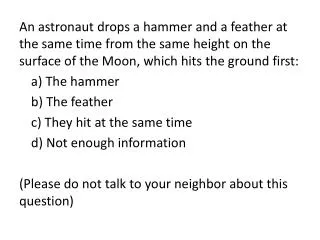
An astronaut drops a hammer and a feather at the same time from the same height on the surface of the Moon, which hits the ground first: a) The hammer b) The feather c) They hit at the same time d) Not enough information (Please do not talk to your neighbor about this question)
If you finish the tutorial early: • Follow the same reasoning that you used in section II of the tutorial by expressing the terminal velocity of an object of mass m for the case in which the force of air resistance is: • quadraticwith respect to speed (c1 = 0, c2 ≠ 0) • is expressed as a combination of both linear and quadratic terms (c1 ≠ 0, c2 ≠ 0) • Find an expression for v(t) from part I. (You sketched this function qualitatively in IB). You will need to solve a differential equation.