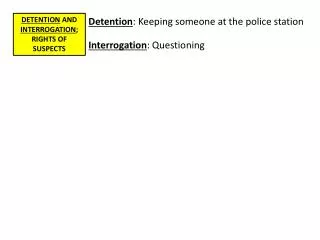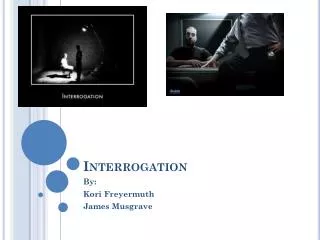
Detention and Interrogation: Legal Standards and Treatment of Detainees
This chapter explores the legal frameworks governing detention and interrogation, focusing on authority to detain under the law of war. It examines which individuals may be detained, including prisoners of war and unlawful combatants, and the applicable treatment standards for detainees. The chapter highlights the evolution of U.S. approaches from the Bush to the Obama administration, key legal principles like due process, and the importance of humane treatment. It concludes with an overview of contemporary treatment standards and ongoing challenges in ensuring compliance with international law.

Detention and Interrogation: Legal Standards and Treatment of Detainees
E N D
Presentation Transcript
Agenda • Authority to Detain • Who Maybe Detained • Interrogation and Treatment of Detainees • Other Treatment Issues • Due Process • Conclusion
Authority to Detain • Nature of the Law of War – prohibitive effect • Detention Authority Derived from Authority to Wage War [Hamdi] • Bush Administration • Emphasis on Presidential Power • But AUMF
Authority to Detain • Obama Administration – March 13th Memo • AUMF (not Presidential authority) • Al Qaeda, Taliban and associated forces • “As informed by the laws of war” • Habeas Cases • “Part of or substantially supporting” • Functional membership test • Al Bihani and the role of international law
Who May Be Detained • Prisoners of War, GC III • Categories of Article 4 • Civilian Internees, GC IV • Unlawful Combatants, CIL?
Prisoners of War • Members of the armed forces • Militia who comply with four provisions: • Are under responsible command. • Carry their arms openly. • Fixed, distinctive insignia, recognizable at a distance. • Comply with the law of war • Civilians accompanying the force • Levée en mass
Civilian Internees • Protected Persons, under Art. 4, GC III • Restraints on Liberty: • Assigned Residence • Internment Camps • Art. 42, Civilians in the territory of the enemy • Art. 78, Reasons for Internment: • Imperative Threats to Security • Safety of the Civilians
Unlawful Combatants • Historical Debate [see Chapter 5] • Unlawful Combatants – the Bush approach • Not associated with a state • Did not distinguish/comply with the law of war • Pres. declaration of the class/detention authority • Military Commissions Acts • Authority to prosecute [detain?] • Based on AUMF • Compared to lawful combatants • Now “Unprivileged Belligerents”
Interrogation – GPW Standards • Name, rank and serial number • Red Cross identification cards • Limitations on Interrogation: • No torture • No outrages upon personal dignity • No public humiliation • No coercion • No “disadvantageous treatment of any kind”
Interrogation - Controversy • Bush - “treat humanely, consistent with military necessity” • Torture Memos - torture narrowly defined • Debate over: • Cruel and Degrading Treatment • Outrages on Personal Dignity • “Torture light” from the Convention Against Torture • 5th Amendment Due Process, “shock the conscience”?
Some Cruel/Degrading Treatment Examples: • Beatings - Brazil, Burma, China, Egypt, Eritrea, Indonesia, Iran, Iraq, Libya, North Korea, Pakistan, Saudi Arabia, Tunisia, Turkey, Uzbekistan, Zimbabwe • Binding/Shackling of Limbs - China, Eritrea, Israel, Pakistan • Blindfolding - Egypt, Israel, Turkey • Branding - Iraq • Burning - Iran, Iraq, Libya, Pakistan, Turkey • Denial of Food/Water - Burma, Iraq, Libya, North Korea, Pakistan , Tunisia, Turkey, Zimbabwe • Dog Attacks - Libya • Dripping Water on Head - Turkey • Electric Shocks - Brazil, China, Egypt, Indonesia, Iraq, Libya, North Korea, Pakistan, Tunisia, Turkey, Uzbekistan • Exposure to Excessive Heat/Cold - Eritrea, Indonesia, North Korea, Turkey • Forced Painful Positions - Burma, Israel, North Korea
More Cruel/Degrading Treatment Examples: • Humiliation - Indonesia, Israel, North Korea, Pakistan, Turkey • Mock Executions – Turkey • Sexual Assaults - Egypt, Eritrea, Iraq, Libya, Pakistan , Tunisia, Turkey, Uzbekistan • Slapping – Turkey • Sleep Deprivation - Indonesia, Iran, Israel, Jordan, Libya, Saudi Arabia, Turkey • Solitary Confinement - China, Iraq, Jordan, North Korea, Pakistan, Tunisia • Stripping – Turkey • Submersion (Water-boarding) - Brazil, Tunisia • Suffocation - Indonesia, Libya, Uzbekistan • Suspension/Hanging by Limbs - Egypt, Indonesia, Iran, Iraq, Jordan, Libya, North Korea, Pakistan, Saudi Arabia, Tunisia, Turkey • Threats (esp. of sexual abuse)
Interrogation – Restoring Standards • Detainee Treatment Act • Define the limits of cruel treatment • Banned serious physical/mental maltreatment • Common Article 3 and the Minimum Standards from AR 190-8 • EO 13440 – preserving CIA Interrogation Methods • FM 2-22.3 and Obama – back to GPW Standards
Other Treatment Issues • Minimum Humane Treatment Standards • Detention Standards • Obama EO on Guantanamo • Current Treatment Standards
DoD Directive and AR 190-8, General Protection Policy • Common Article 3 • All prisoners will receive humane treatment without regard to race, nationality, religion, political opinion, sex, or other criteria. • The following acts are prohibited: murder, torture, corporal punishment, mutilation, the taking of hostages, sensory deprivation, collective punishments, execution without trial by proper authority, and all cruel and degrading treatment.
GC Common Standards • Communal living • Adequate shelter/protection from harm • Medical care • Communication with the outside world • Camp administration • Food and hygiene • Religious accomodation • Education/recreation
Current Treatment Standards • Obama EO on Guantanamo • Humane Treatment • Walsh Report • Army Field Manuals and Regulations • AR 190-8 • FM 3-19.40 • Derogations only for “imperative reasons of security”. . . never below minimum standards
What Process is Due? • Article 5 (GPW) Tribunals • Article 78 (GC) Review • Hamdi – Administrative Due Process • CSRT’s and ARB’s • Boumediene • Habeas Explosion • Maqaleh – impact on the battlefield? • May 7th, 2011, Executive Order
Due Process Example • Law of war the lex specialis • Detainee Review Boards in Afghanistan • Independent Admin Boards • Witnesses and Evidence • Personal Representatives • Security Threat Standards • What about Human Rights Standards? • As a requirement or aspiration? • As a goal for transition to Host Nation?
Conclusion • Impact of Litigation • Domestic (or human rights) law • Guantanamo, wagging the dog? • Habeas litigation . . . • Prospects for Legislation? • Policy Changes • Law of War Impact (lex specialis) • Interrogation and Treatment • No more “no law zone”!