Mawrth Vallis: Habitability and Biosignature Preservation Insights for Future Exploration
This document discusses the habitability and biosignature preservation in Mawrth Vallis, highlighting the evaluation of biosignature formation, concentration, and preservation in impact-related rocks. It notes the significance of impact events, which generate long-lasting heat and hydrothermal systems potential for life. The paper raises critical questions about the presence of these systems within rover range, and the challenges posed by impact erosion and alteration of potential biosignatures. Future investigations are expected to explore these factors further to assess the region's suitability for habitability.

Mawrth Vallis: Habitability and Biosignature Preservation Insights for Future Exploration
E N D
Presentation Transcript
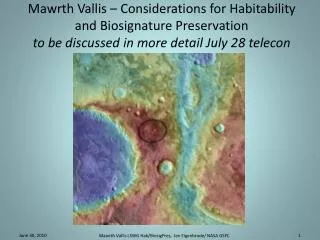
Mawrth Vallis – Considerations for Habitability and Biosignature Preservationto be discussed in more detail July 28 telecon Mawrth Vallis LSWG Hab/BiosigPres, Jen Eigenbrode/ NASA GSFC
Evaluation of support for biosignature formation, concentration, and preservation (FCP) for impact-related rocks • Impacts provide heat that can linger for 1000’s to 10,000’s years (more?) • Water, chemical and thermal energy flux Support for Biosignature FCP Post-impact impact-generated hydrothermal system (surface and subsurface) high Do we have this at Mawrth in rover range? impact-generated crater lake high Pre-Impact Rocks IMPACT impact-related fluvial environments low impact-independent sediments accumulated in catchment Dependent on depositional environment ? impact-independent diagenetic conditions (e.g. pedogenesis) low Was this a significant process at Mawrth in the rover area? Mawrth Vallis LSWG SOWG Hab/BiosigPres, J. Eigenbrode/ NASA GSFC
Evaluation of support for biosignature formation, concentration, and preservation (FCP) for impact-related rocks Impact craters provide access to bedrock Post-impact Sedimentary record that supports biosignature FCP • Biosignatures in sedimentary rock that are excavated from or proximal to impact craters are susceptible to alteration/destruction by: • impact erosion, subsequent oxidation and weathering • shock metamorphism* • hydrothermal alteration* • redistribution* • overprinting by later life* • Context and framework complicated or lost. • Details saved for future telecon. With respect to Mawrth… Searching for habitability features and biosignatures from the time of rock deposition is an option for a Mawrth MSL investigation, but risky given so many uncertainties. optimism IMPACT Pre-Impact Rocks Mafic rock/ lava (biosignature FCP unlikely) • No pre-impact biosignatures to preserve Subsurface viable life Topic of future discussion Mawrth Vallis LSWG Hab/BiosigPres, J. Eigenbrode/NASA GSFC