Plate Tectonics
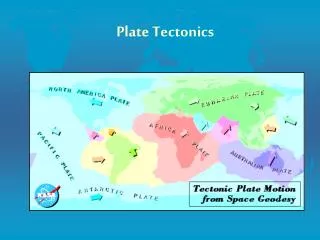
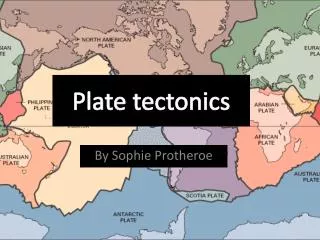
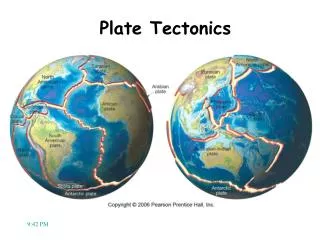
Plate Tectonics. http://www.learner.org/interactives/dynamicearth/images/new_map.jpg. Tectonic Plates. The Earth’s crust is made of many gigantic plates that move as they ‘float’ on the mantle. According to the theory of continental drift, the plates are moving.
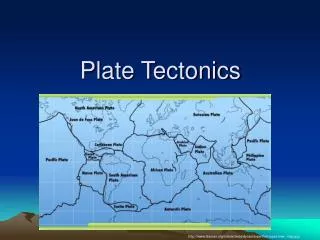

Plate Tectonics
E N D
Presentation Transcript
Plate Tectonics http://www.learner.org/interactives/dynamicearth/images/new_map.jpg
Tectonic Plates • The Earth’s crust is made of many gigantic plates that move as they ‘float’ on the mantle. • According to the theory of continental drift, the plates are moving. • Europe and North America are thought to be moving away from each other 3cm each year. • Other plates are moving toward each other and some are sliding against each other. • Wherever plates meet, earthquakes signal their movement.
Pangaea • Have you ever noticed that the continents look like puzzle pieces? • In 1912, Alfred Wegener suggested that millions of years ago the continents were all part of one big continent called Pangaea. http://upload.wikimedia.org/wikipedia/commons/1/16/Wegener_Expedition-1930_008.jpg
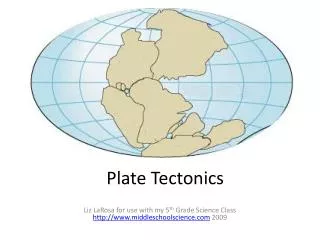
Pangaea http://azgenweb.org/navajo/History/Petrified/Pangaea_continents.png
Continental Drift • Wegener suggested that Pangaea had broken apart and that the continents had and still are drifting apart. • This theory is called Continental Drift • At the time, Wegener’s theory was dismissed as he had no evidence besides the fact that the continents fit together. http://newpangaea.eu/sitebuildercontent/sitebuilderpictures/Pangaea.JPG
The Evidence • Certain fossils of extinct reptiles found only in Africa and South America. • Fossils of plants and animals found in Antarctica, which is now inhabitable. • Rocks similar in age and type found along the coasts of continents that fit together. http://www.lostrivers.ca/points/pangaea.gif
Plate Tectonics Theory • Theory that states that the Earth’s crust is made up of several large sections called plates. • These plates are slowly moving, floating on top of the Earth’s mantle. • Continents drift by riding on top of the plates. http://www.geography-site.co.uk/pages/physical/earth/images/plates.gif
Sliding-By Plates • When two plates slide against each other, a fault is formed. • The plates do not collide or separate; they just slip by. • Ex) The San Andreas Fault in California. http://lacreekfreak.files.wordpress.com
Plate Collisions • When two plates collide, one plate usually plunges below into the hot mantle where it heats up and melts. • This process is called subduction. http://whyfiles.org/031volcano/images/subduction.gif
Separating Plates • When two plates move apart, magma from the mantle rises up into the crack between the two plates and hardens. • This forms ridges of new rock. • Ridges usually form under the ocean but does occur in Iceland also. http://www.utexas.edu/tmm/npl/mineralogy/blowups/oceanicridge.jpg