Download
1 / 14
140 likes | 267 Views
This presentation explores the impact of Black Codes and the challenges faced during Reconstruction. We will analyze the purpose of Black Codes in restoring pre-emancipation systems, discuss the political unpreparedness of newly freed blacks, and assess the significance of the 15th Amendment. The effects of the Reconstruction era, including the rise of "Redeemers," the Civil Rights Act of 1875, and the implications of the Plessy v. Ferguson case, will be examined. Join us in understanding the extent of freedom gained by former slaves and the overall success of Reconstruction.

E N D
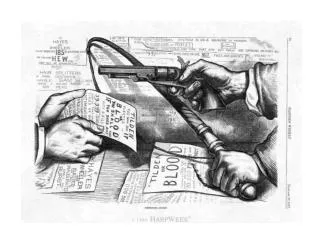
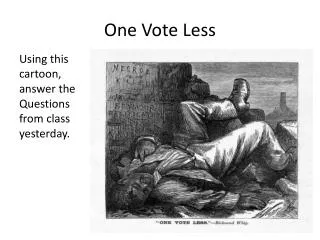
One Vote Less Using this cartoon, answer the Questions from class yesterday.
Black "Adjustment" in the South
Black Codes • Purpose: • Guarantee stable labor supply now that blacks were emancipated. • Restore pre-emancipationsystem of race relations. • Forced many blacks to become sharecroppers [tenant farmers].
Blacks in Southern Politics • Core voters were black veterans. • Blacks were politically unprepared. • Blacks could register and vote in states since 1867. • The 15th Amendment guaranteedfederal voting.
15th Amendment • Ratified in 1870. • The right of citizens of the United States to vote shall not be denied or abridged by the United States or by any state on account of race, color, or previous condition of servitude. • The Congress shall have power to enforce this article by appropriate legislation. • Women’s rights groups were furious that they were not granted the vote!
The Failure of Federal Enforcement • Enforcement Acts of 1870 & 1871 [also known as the KKK Act]. • “The Lost Cause.” • The rise of the“Bourbons.” • Redeemers (prewarDemocrats and Union Whigs).
The Civil Rights Act of 1875 • Crime for any individual to deny full &equal use of public conveyances andpublic places. • Prohibited discrimination in jury selection. • Shortcoming lacked a strong enforcement mechanism. • No new civil rights act was attemptedfor 90 years!
The Abandonment of Reconstruction
Northern Support Wanes • “Grantism” & corruption. • Panic of 1873 [6-yeardepression]. • Concern over westwardexpansion and Indian wars. • Key monetary issues: • should the government retire $432m worth of “greenbacks” issued during the Civil War. • should war bonds be paid back in specie orgreenbacks.
Plessy v. Ferguson (1898) • Louisiana passes a “Separate Car Act,” where railway passengers are separated (by race) into different, but equal cars. • The Supreme Court ruled that it was not unconstitutional to separate by race as long as the facilities are equal. • This was the beginning of the idea of “separate, but equal” that would dominate society until the 1950’s.
Presentation format • 1st section- Introduce the document. • Who wrote it? What year was it written? What is going on in history at this time period? Etc. • 2nd section- Present the document. • What is the main idea? What perspective does it illustrate? • 3rd section- Relate it to either essential question. • EQ: To what extent did former slaves gain their freedom during Reconstruction? To what extent was Reconstruction successful?