Classification
Classification. This is Panorpa japonica. Commonly known as the scorpion fly. Carolus Linnaeus. Created the classification system and binomial nomenclature. Taxonomy. Taxonomy is the science of naming and classifying organisms.


Classification
E N D
Presentation Transcript
Classification This is Panorpa japonica. Commonly known as the scorpion fly.
Carolus Linnaeus • Created the classification system and binomial nomenclature.
Taxonomy • Taxonomy is the science of naming and classifying organisms. • Linnaean taxonomy classifies organisms based on their physical and structural similarities.
Taxonomy • Organisms are placed on different levels in which each level is included in a larger, more general level. • A group of organisms in a classification system is called a taxa. • The most basic taxon is species.
Binomial Nomenclature • Binomial nomenclature is a system that gives each species a two-part scientific name using Latin words. • The first part of the name is the genus, which is always capitalized. • The second part of the name is the species. It is always lowercase.
Scientific Names • Why do biologists use scientific names? • Genera may contain hundred of species that have very similar common names. • Scientific names allow scientists to talk about particular species without confusion.
Linnaeus classification system has seven levels • From the most general to the most specific: • Kingdom • Phylum • Class • Order • Family • Genus • Species
Dichotomous Keys • Dichotomous keys are used to identify organisms through a series of steps. • A dichotomous key is made up of paired statements. (di = two) • Each object fits into one category or the other, but not both.
The Linnaean classification system has limitations. • The Linnaean system focuses on physical similarities alone. • Today, scientists use genetic research to help classify organisms. • Genetic similarities between two organisms are more likely than physical similarities to be due to a common ancestor.
Phylogeny • The evolutionary history for a group of species is called phylogeny. • To classify species, scientists look at more than just physical traits. • They use living species • the fossil record • DNA data • Phylogenies can be shown as branching tree diagrams.
Cladistics • Cladistics is classification based on common ancestry. • The goal of cladistics is to place species in the order in which they descended from a common ancestor. • A cladogram is an evolutionary tree that proposes how species may be related to each other through common ancestors.
Derived Characters • Derived characters are traits that can be used to figure out evolutionary relationships. • Cladograms are made by figuring out which derived characters are shared by which species. • The more closely a related species are, the more derived characters they will share. Derived Characters: Organisms that branch off after a hash mark share the derived character represented by the hash mark. A bony skeleton is a derived character. Sharks do not have this derived character.
Interpreting a Cladogram • Derived characters are shown as hash marks between the branches of a cladogram. • All species above a hash mark share the derived character it represents. • This order is hypothesized to be the order in which they descended from their common ancestor. Derived Characters
Interpreting a Cladogram • Nodes • Each place where a branch splits is called a node. • Nodes represent the most recent common ancestor shared by a clade. • Identifying Clades • A clade is a group of organisms that share certain traits derived from a common ancestor. Nodes: In a cladogram, a node is the intersection of two branches. This node represents the most recent common ancestor shared by the entire mammalian clade. Clade: A clade is a group of organisms that share certain traits derived from a common ancestor.
Molecular evidence reveals species’ relatedness. • An evolutionary tree is always a work in process. • Hormones, proteins, and genes are all used to help learn about evolutionary relationships. • DNA is considered to be the “last word” when figuring out how related two species are to each other. • The more similar to each other the genes of two species are, the more closely related the species are likely to be. Bonobo Chimpanzee
Molecular Clocks • Molecular clocks are models that use mutation rates to measure evolutionary time. • Mutations are nucleotide substitutions in DNA, some of which cause amino acid substitutions in proteins. • These mutations tend to add up at a constant rate for a group of related species. • The more time that has passed since two species have diverged from a common ancestor, the more mutations will have built up in each lineage, and the more different the two species will be at the molecular level.
Linking molecular data with time. • Scientists must find links between molecular data and time. • A geologic event that is known to have separated a species allows scientists to give a real date to the rate of mutation. • For example: Scientists know that the marsupials of Australia and those of South America diverged about 200 million years ago, when these two continents split. • A link can also come from fossil evidence. • Molecular data can be compared to the first appearance of each type of organism in the fossil record. South American “Monito del Monte”—Monkey of the Mountains. A marsupial. Austrailian bandicoot. A marsupial.
Mitochondrial DNA (mtDNA) • Mitochondrial DNA is found only in mitochrondria. • mtDNA is always inherited from the mother. • mtDNA is passed down unshuffled through many generations.
Ribosomal RNA (rRNA) • Ribosomal RNA is found only in the ribosomes of cells. • rRNA accumulates mutations VERY slowly.
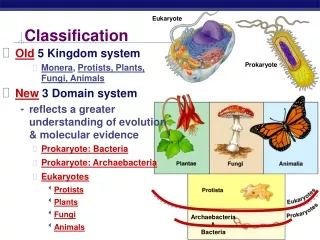
Classification is always a work in progress. • 1753—two kingdoms • Animalia and Plantae • 1866—three kingdoms • Animalia, Plantae, Protista • 1938—four kingdoms • Animalia, Plantae, Protista, Monera • 1959—five kingdoms • Animalia, Plantae, Protista, Monera, Fungi • 1977—six kingdoms • Animalia, Plantae, Protista, Archaea, Bacteria, Fungi This is wrong!
Eukarya • All organisms with eukaryotic cells. • May be single-celled, colonial, or multicellular. • Includes the kingdoms Protista, Plantae, Fungi, and Animalia.
Archaea • Single-celled prokaryotes. • Cell walls are chemically different from bacteria—allows achaea to live in extreme environments. • Archaea are found in deep sea vents, hot geysers, Antarctic waters, salt lakes, and in the middle of volcanoes.
Bacteria • Single-celled prokaryotes. • Largest groups of organisms on Earth. • There are more bacteria in your mouth than there are people that have ever lived!