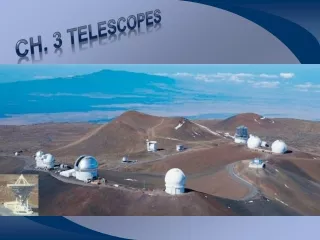
Exploring the Universe: Evolution of Telescopes
570 likes | 596 Views
Delve into the advancements in telescope technology, from optical instruments to space telescopes, covering radio astronomy and interferometry. Discover how these tools revolutionize our understanding of the cosmos.


Exploring the Universe: Evolution of Telescopes
E N D
Presentation Transcript
INTRO In astronomy, observation usually precedes theory. Ex/ New solar syst.; acc. univ. Telescopes have grown in size and complexity and now cover the entire EM spectrum
I. Optical Telescopes A. Telescope: A “light bucket” used to capture incoming photons & concentrate them into a focused beam for analysis.
B. Types of Telescopes • Refractors: A glass lens bends (refracts) incoming light rays to a focus. Eyepiecemagnifies.
2. Reflectors: A curved mirror (the primary mirror) reflects incoming rays to a focus. Eyepiece magnifies.
D. Reflector Design 1.Newtonian: Secondary mirror reflects light to side eyepiece. Subcategory: Dobsonian
2. Cassegrain: Secondary mirror reflects light back thru a hole in the primary mirror.
II. Telescope Size & Resolution A. Light-gathering power: Larger collecting area - brighter image. 1. Brightness ~ Diameter2 Ex/ 10”apertureis 25 x brighter than 2”aperture (or 25 x faster exposure) 2. Largest: VLT in Chile (16 m) Keck I & II in Hawaii (14 m) TMT (2018); Giant Magellan Telescope (2016)
Ch. 5 Example Problem How long would it take a telescope with a 9” aperture to produce the same image that a 3” scope can make in 45 min.?
B. Resolving Power: Ability to make sharp images of faint objects or to distinguish between 2 adjacent objects in the sky.** aka Angular Resolution
C. Atmospheric Blurring 1. Hinders ground-based scopes Ex/ “twinkling” stars 2. Best locations- high, dry, & dark Ex/ Arizona; Chile; Hawaii 3. Another solution - space. Ex/Hubble (1993) - 20 x better than previous best
D. Adaptive Optics: Mirror changes shape to compensate for atmosphere. a. Lasers pierce atmosphere, create “artificial star” b. Some now sharper than Hubble! Ex/ Subaru (IR), Keck, VLT
III. Radio Astronomy & Interferometry A. Radio telescopes 1. Only since the‘50’s Grote 2. Pioneers- Karl Jansky, Reber 3. Curved metal dish focuses radio waves to a focal point. 4. Instruments located at the prime focus.
B. Large Size Necessary 1. Signals are faint 2. Long wavelength radio diffracts greatly - poor resolution a. Surface doesn’t have to be smooth like optical scopes b. It’s easy to make them large Ex/ Largest: Arecibo– 1000 ft. wide!(305 m)
C. Value of Radio Astronomy 1. 24 / 7 2. Thru clouds, rain, snow 3. Objects visibly dim may be strong radio sources. Ex/ *4. Radio penetrates dust in space. Ex/ Center of our galaxy
D. INTERFEROMETRY 1. Interferometer: Data from 2 or more scopes combined. Ex/ VLA in N. Mex (27 dishes) ATA (2007)- 42 dishes ALMA (2012) - 66 Square Kilometer Array (2020) - 150 dishes 2. Behaves like a single dish whose diameter is the distance between dishes. Ex/ Compound eye
A. Microwave satellites IV. Space Telescopes • COBE (1990’s) - Measured the cosmic microwave background Proof of the Big Bang! 2. Planck (2009)
B. INFRARED Astronomy 1. Long wavelength IR penetrates clouds in space. 2. Good for star or planet-forming clouds of warm dust & gas. 3. Mountaintops Ex/ Subaru 4. Airplanes Ex/ SOFIA 5. Or Space Ex/ Spitzer James Webb Space Tel. (2018)
James Webb Space Telescope“Successor to the Hubble” ~ 6.5 m mirror Launch in 2018 (?) Infrared
C. Visible light: 1.Hubble Space Telescope 2. Spherical aberration corrected 1993 3. Final repair mission 2009