Data Science Executive Course
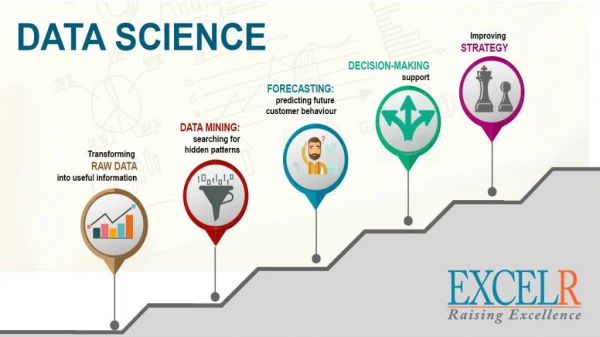
Data science is the detective work that fuels the creativity of Generative AI (Gen AI). Imagine data scientists as the sheriffs, sifting through mountains of information to uncover hidden patterns. These insights are then used to train Gen AI models, allowing them to generate realistic data, create art, or even write code u2013 like having a magic toolbox for AI! It's a revolutionary field where data science unlocks the true potential of Gen AI, transforming industries and shaping the future.

Data Science Executive Course
E N D
Presentation Transcript
Generative AI: Unleashing the Power of Machine Creativity Table of Contents 1. Introduction: The Rise of Generative AI 2. Understanding Generative AI: Foundations and Concepts 3. Applications of Generative AI Across Industries
4. Deep Learning and Neural Networks: The Core of Generative AI 5. Challenges and Ethical Considerations in Generative AI 6. Future Trends in Generative AI 7. Data Science Executive Course: Advancing Your Expertise 8. Conclusion: Embracing the Future with Generative AI Introduction: The Rise of Generative AI Generative AI is one of the most fascinating advancements in artificial intelligence. Unlike traditional AI, which typically follows predefined rules to analyze data and make predictions, generative AI creates new content, such as images, music, text, and even complex 3D models. This capability opens up a world of possibilities, from enhancing creative processes to revolutionizing industries with innovative solutions. The surge in generative AI's popularity is driven by advancements in machine learning, particularly deep learning and neural networks. These technologies enable machines to learn patterns and generate outputs that are indistinguishable from those created by humans. As generative AI continues to evolve, its impact on various sectors, from entertainment to healthcare, becomes increasingly profound. Understanding Generative AI: Foundations and Concepts The Basics of Generative AI Generative AI involves algorithms that can produce new data by learning from existing data. These algorithms can create anything from artwork to realistic human faces, all without direct human intervention. Key techniques in generative AI include Generative Adversarial Networks (GANs), Variational Autoencoders (VAEs), and Transformer models. Each technique has its own strengths and is suited to different types of generative tasks. Generative Adversarial Networks (GANs) consist of two neural networks—a generator and a discriminator—that work together in a competitive manner. The generator creates new data instances, while the discriminator evaluates them against real data. Through this process, the generator improves its output, producing increasingly realistic data.
Key Concepts and Techniques Variational Autoencoders (VAEs) are another popular method in generative AI. VAEs learn to encode data into a latent space and then decode it back into the original format. This process allows for the generation of new data points that are similar to the original dataset but not identical, making VAEs useful for creating new variations of existing data. Transformer models, particularly those used in natural language processing (NLP), like GPT-3, have shown remarkable capabilities in generating human-like text. These models use self-attention mechanisms to understand and generate text based on the context, leading to highly coherent and contextually appropriate outputs. Applications of Generative AI Across Industries Transforming Creative Industries Generative AI is making waves in creative fields such as art, music, and literature. Artists and musicians use AI tools to explore new styles and compositions, pushing the boundaries of creativity. For instance, AI-generated artwork has been sold at prestigious auctions, and AI-composed music is being used in films and commercials. In the fashion industry, generative AI helps designers create new patterns and styles, speeding up the design process and enabling rapid prototyping. The ability to generate unique designs on demand is revolutionizing the way fashion collections are created and presented. Efficiency and Productivity Gains: •Data Augmentation Powerhouse: A study by Intel suggests that generative AI models can increase the effectiveness of data used in machine learning tasks by up to 40% through data augmentation. This translates to improved model performance and reduced reliance on scarcely labeled data. •Automating Tedious Tasks: Generative AI can automate repetitive tasks such as data cleaning, preprocessing, and feature engineering, freeing up data scientists' time for more strategic analysis and model development Towards Data Science, "Generative AI for Data Science. A study by IDC predicts that automation using AI will save data scientists 30% of their time by 2024 .
Revolutionizing Healthcare and Biotech In healthcare, generative AI is being used to design new drugs and medical treatments. By analyzing vast amounts of biomedical data, generative models can identify potential compounds for new drugs, significantly reducing the time and cost of drug discovery. AI- generated molecular structures are also aiding in the development of personalized medicine, tailored to individual genetic profiles. In medical imaging, generative AI enhances the quality of images and assists in the diagnosis of diseases. By generating high-resolution images from low-quality inputs, AI improves the accuracy of diagnoses and helps medical professionals make better- informed decisions. Deep Learning and Neural Networks: The Core of Generative AI The Role of Deep Learning Deep learning is a subset of machine learning that uses neural networks with many layers (hence "deep") to analyze data. These networks can learn complex patterns and representations, making them ideal for tasks like image and speech recognition, and, crucially, data generation. In generative AI, deep learning enables the creation of realistic and high-quality outputs. Neural networks, particularly convolutional neural networks (CNNs) and recurrent neural networks (RNNs), form the backbone of many generative AI systems. CNNs are widely used for image generation tasks, while RNNs and their variants (like LSTMs and GRUs) are used for sequential data generation, such as text and music. Training Neural Networks Training neural networks for generative tasks involves large datasets and significant computational power. During training, the network adjusts its parameters to minimize the difference between its generated output and the real data. This process, known as
backpropagation, is computationally intensive but essential for creating effective generative models. Advanced training techniques, such as transfer learning and reinforcement learning, enhance generative AI capabilities. Transfer learning allows models to leverage knowledge from pre-trained networks, reducing the amount of data and time required for training. Reinforcement learning, on the other hand, enables models to learn through trial and error, improving their performance over time. Challenges and Ethical Considerations in Generative AI Challenges and Considerations: •Bias and Explainability: According to MIT Generative AI models can inherit biases present in the training data. Ensuring fairness and understanding how these models generate outputs remain crucial challenges. •Computational Requirements: Training complex generative models can require significant computational resources, limiting accessibility for some organizations Data Given by Tech Crunch. Addressing Technical Challenges Despite its potential, generative AI faces several technical challenges. One major issue is the quality of generated data. Ensuring that AI-generated content is indistinguishable from human-created content requires sophisticated models and extensive training. Additionally, generating diverse and contextually accurate content remains a significant challenge. Another challenge is the computational resources required for training generative models. High-performance hardware and substantial energy consumption are often necessary, raising concerns about the environmental impact and accessibility of generative AI technologies. Ethical and Social Implications Generative AI also raises important ethical questions. The ability to create realistic images, videos, and text can be misused for malicious purposes, such as deepfake videos and
disinformation campaigns. Ensuring the responsible use of generative AI requires robust regulations and ethical guidelines. Privacy concerns are also paramount. Generative models trained on personal data can inadvertently reveal sensitive information. Establishing clear policies on data usage and ensuring compliance with privacy laws are essential steps in addressing these concerns. Future Trends in Generative AI Advances in Model Architectures The future of generative AI lies in the continued development of model architectures. Emerging models, such as GAN variants and advanced transformer models, are pushing the boundaries of what AI can generate. These advancements promise even more realistic and high-quality outputs, expanding the potential applications of generative AI. Moreover, the integration of generative AI with other technologies, such as augmented reality (AR) and virtual reality (VR), will create new immersive experiences. AI-generated content will enhance AR and VR environments, providing users with dynamic and interactive experiences. Expanding Applications As generative AI technology matures, its applications will continue to expand. In the entertainment industry, AI-generated content will become increasingly prevalent in films, video games, and virtual environments. In education, generative AI will create personalized learning materials and simulations, enhancing the learning experience. In business, generative AI will streamline content creation, from marketing materials to product designs. By automating repetitive tasks and generating innovative solutions, AI will drive efficiency and creativity across various sectors. Data Science Executive Course: Advancing Your Expertise The Importance of Advanced Training As generative AI becomes more integral to various industries, advanced training is essential for professionals looking to harness its potential. A Data Science executive
course provides the in-depth knowledge and skills needed to master generative AI technologies. These courses cover a wide range of topics, from the fundamentals of machine learning to advanced neural network architectures. Enrolling in a Data Science Executive course ensures that professionals stay ahead of the curve, equipped with the latest tools and techniques to leverage generative AI effectively. These courses often include hands-on projects, allowing participants to apply their learning to real-world scenarios. Career Advancement Opportunities A Data Science executive course opens up numerous career opportunities. Professionals with expertise in generative AI are in high demand across industries such as technology, finance, healthcare, and entertainment. The ability to develop and implement generative AI solutions sets candidates apart in the competitive job market. Additionally, these courses often provide networking opportunities with industry leaders and peers, fostering connections that can lead to collaborative projects and career advancement. By investing in a Data Science executive course, professionals can future- proof their careers and become leaders in the field of generative AI. Conclusion: Embracing the Future with Generative AI Generative AI is transforming the way we create and interact with content, offering unprecedented possibilities across various industries. From enhancing creative processes to revolutionizing healthcare and business, the impact of generative AI is profound and far- reaching. Understanding the foundations, applications, and future trends of generative AI is essential for leveraging its potential effectively. Investing in advanced training, such as a Data Science executive course, equips professionals with the skills and knowledge needed to navigate this rapidly evolving field. By embracing generative AI and its transformative power, individuals and organizations can stay ahead of the curve and drive innovation in the digital age. The future of creativity and technology lies in the hands of those who dare to explore the limitless possibilities of generative AI.