### Exploring the Effects of Slit Width and Wavelength in Diffraction Patterns ###
This text examines key concepts in single-slit diffraction experiments, including the relationship between slit width and wavelength on the angular width of diffraction maxima. It discusses scenarios such as increasing or decreasing slit width and light wavelength to determine the effects on the central diffraction maximum's angular width. It also examines multi-slit diffraction patterns in Young’s experiment and x-ray diffraction in crystals, focusing on how patterns change with the number of slits and the mechanisms behind the formation of diffraction patterns. ###

### Exploring the Effects of Slit Width and Wavelength in Diffraction Patterns ###
E N D
Presentation Transcript
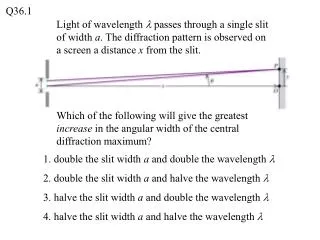
Q36.1 Light of wavelength l passes through a single slit of width a. The diffraction pattern is observed on a screen a distance x from the slit. Which of the following will give the greatest increase in the angular width of the central diffraction maximum? 1. double the slit width a and double the wavelength l 2. double the slit width a and halve the wavelength l 3. halve the slit width a and double the wavelength l 4. halve the slit width a and halve the wavelength l
A36.1 Light of wavelength l passes through a single slit of width a. The diffraction pattern is observed on a screen a distance x from the slit. Which of the following will give the greatest increase in the angular width of the central diffraction maximum? 1. double the slit width a and double the wavelength l 2. double the slit width a and halve the wavelength l 3. halve the slit width a and double the wavelength l 4. halve the slit width a and halve the wavelength l
Q36.2 In a single-slit diffraction experiment with waves of wavelength l, there will be no intensity minima (that is, no dark fringes) if the slit width is small enough. What is the maximum slit width a for which this occurs? 1. a = l/2 2. a = l 3. a = 2l 4. answer depends on the distance from the slit to the screen on which the diffraction pattern is viewed
A36.2 In a single-slit diffraction experiment with waves of wavelength l, there will be no intensity minima (that is, no dark fringes) if the slit width is small enough. What is the maximum slit width a for which this occurs? 1. a = l/2 2. a = l 3. a = 2l 4. answer depends on the distance from the slit to the screen on which the diffraction pattern is viewed
Q36.3 In Young’s experiment, coherent light passing through two slits separated by a distance d produces a pattern of dark and bright areas on a distant screen. If instead you use 10 slits, each the same distance d from its neighbor, how does the pattern change? 1. the bright areas move farther apart 2. the bright areas move closer together 3. the spacing between bright areas remains the same, but the bright areas become narrower 4. the spacing between bright areas remains the same, but the bright areas become broader
A36.3 In Young’s experiment, coherent light passing through two slits separated by a distance d produces a pattern of dark and bright areas on a distant screen. If instead you use 10 slits, each the same distance d from its neighbor, how does the pattern change? 1. the bright areas move farther apart 2. the bright areas move closer together 3. the spacing between bright areas remains the same, but the bright areas become narrower 4. the spacing between bright areas remains the same, but the bright areas become broader
Q36.4 In an x-ray diffraction experiment using a crystal, a pattern of bright spots is formed by 1. interference of x-rays scattered by different atoms in the crystal 2. interference of x-rays emitted by different atoms in the crystal 3. interference of x-rays scattered by different parts of an individual atom in the crystal 4. interference of x-rays emitted by different parts of an individual atom in the crystal
A36.4 In an x-ray diffraction experiment using a crystal, a pattern of bright spots is formed by 1. interference of x-rays scattered by different atoms in the crystal 2. interference of x-rays emitted by different atoms in the crystal 3. interference of x-rays scattered by different parts of an individual atom in the crystal 4. interference of x-rays emitted by different parts of an individual atom in the crystal
Q36.5 You use a telescope lens to form an image of two closely-spaced, distant stars. Which of the following will increase the resolving power? 1. use a filter so that only the blue light from the stars enters the lens 2. use a filter so that only the red light from the stars enters the lens 3. use a lens of smaller diameter 4. more than one of the above
A36.5 You use a telescope lens to form an image of two closely-spaced, distant stars. Which of the following will increase the resolving power? 1. use a filter so that only the blue light from the stars enters the lens 2. use a filter so that only the red light from the stars enters the lens 3. use a lens of smaller diameter 4. more than one of the above