Understanding and Calculating Equilibrium Constants (K_eq) in Chemical Reactions
This guide explains the determination of equilibrium constants (K_eq) for various chemical reactions, emphasizing their dependence on temperature. It walks through the steps of calculating K_eq using molarity at equilibrium based on concentrations of reactants and products. The significance of K_eq values indicates whether the reaction favors reactants or products. Example calculations are provided for several reactions, including the synthesis of ammonia from hydrogen and nitrogen, enhancing understanding of equilibrium concepts in chemistry.

Understanding and Calculating Equilibrium Constants (K_eq) in Chemical Reactions
E N D
Presentation Transcript
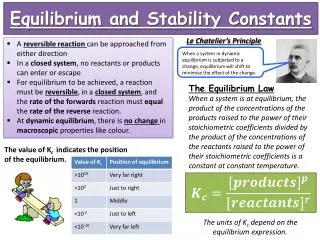
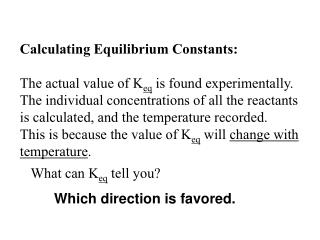
Calculating Equilibrium Constants: The actual value of Keq is found experimentally. The individual concentrations of all the reactants is calculated, and the temperature recorded. This is because the value of Keq will change with temperature. What can Keq tell you? Which direction is favored.
Take the equiibrium: A(g) B(g) • If the value of Keq is one then ….reaction is at equilibrium [A] = [B] • If the value of Keq is less than one ……reactants are favored A(g) B(g) • If the value of Keq is greater than one then ………products are favored A(g) B(g)
Calculating Keq for a reaction: 2SO2(g) + O2(g)2SO3(g) At equilibrium: [SO2 ] = 1.50M [O2 ] = 1.25M [SO3] = 3.50M
Calculating Keq for a reaction: 2SO2(g) + O2(g)2SO3(g) At equilibrium: [SO2 ] = 0.590M [O2 ] = 0.045M [SO3 ] = 0.260M
Calculate the equilibrium constant for the following reaction. 3H2(g) + N2(g) 2NH3(g) if at 25ºC there 0.15 mol of N2 , 0.25 mol of NH3 , and 0.10 mol of H2 in a 2.0 L container.
there 0.15 mol of N2 , 0.25 mol of NH3 , and 0.10 mol of H2 in a 2.0 L container. Change moles to molarity: [N2] = 0.15 mol/2.0L = 0.075 M [H2] = 0.10 mol/2.0L = 0.050 M [NH3] = 0.25 mol/2.0L = 0.125 M
Calculate the equilibrium constant. • Given N2 (g) + 3H2 (g) 2NH3 (g) • At 200ºC, the concentration of nitrogen is 2.12 M, the concentration of hydrogen is 1.75 M, and ammonia is 84.3 M, calculate the equilibrium constant.
Given PCl5 (g) PCl3 (g) + Cl2 (g) • Calculate the equilibrium constant if the equilibrium concentrations are [PCl5 ] = 0.32 , [PCl3 ] = 0.40 and [Cl2 ]= 0.40.
Calculate the equilibrium concentration at 400ºC of NH3, for the reaction: N2 (g) + 3H2 (g) 2NH3 (g) • The equilibrium concentrations for [N2] = 0.45 and [H2] = 1.10. • The keq, at this temperature, is 1.7 x 10⁻².