Understanding Compound Interest: Calculation and Formula Explained
70 likes | 188 Views
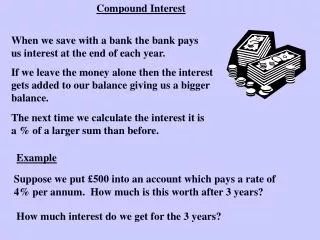
This article explores the concept of compound interest, detailing its calculation and importance. We start with basic definitions like principal amount, rate of interest, and time period, and introduce the compound interest formula: C.A. = P{1 + r/100}^n. Using an example of a principal of Rs. 8000 at a 5% annual rate over 3 years, we calculate the compound amount (C.A.) to be Rs. 9261 and the compound interest (C.I.) as Rs. 1260. This foundational knowledge highlights the significance of mathematics in finance, showcasing its role as the basis of all subjects.


Understanding Compound Interest: Calculation and Formula Explained
E N D
Presentation Transcript
Compound interestsubmittedby Jashwant Singh U.P.S Rampur Maniharan Saharanpur U.P
Principal amount =which amount we have taken from any man or bank Rate =an amount per 100 Rs (yearly or monthly or half yearly ) Time =amount return duration Compound amount =which money we have return from some time
Formula of comopund interest C .A=P{1+r/100}ⁿ Compound interest=(C.A. - P.A.)
if P=8000 Rate =5%year Time =3 year Then Find the C.A and C.I.
c.A =P(1-R/100)ⁿ =8000*105/100*105/100*105/100 =21*21*21 =9261 Rs
Now Compound interest=C.A -P.A =9260-8000 =1260 Rs
Thank you Mathematic is the father of all subjects