Mastering Regular -ER Verb Conjugation in French
110 likes | 230 Views
Discover the essentials of conjugating regular -ER verbs in French with our comprehensive guide! Regular verbs consist of two parts: the stem and the ending. Learn how to break down verbs, such as "goûter," and practice with examples like "regarder," "marcher," and "aimer." We will explore how to use the pronoun chart for conjugation and translate verbs between their infinitive and conjugated forms. Understanding these verbs is crucial, as they are common in everyday conversation. Join us in making -ER verb conjugation fun and easy to master!


Mastering Regular -ER Verb Conjugation in French
E N D
Presentation Transcript
How to conjugate with REGULAR -ER VERBS
Parts of the verb • Regular verbs have two parts, • the stem • the ending Just like we have two hands!!!
-er verbs always end with the letters er, so the rest of the word is called the stem. A verb like goûter breaks down like this: stem = goût ending= er
Your turn • So, how do you think these words will break down? • regarder • marcher • aimer Stem= regard ending=er stem= march stem= aim
Conjugation • In order to conjugate, we first have to remember the pronoun chart! What’s that?!
The pronoun chart JE NOUS TU VOUS IL/ELLE ILS/ELLES
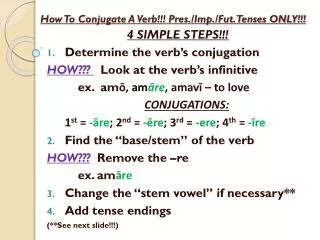
To conjugate an -er verb, all you have to do is take off the ending and add the different pronoun specific endings! Before you take off the ending, the verb is known as an infinitive. After you have put it with a pronoun, it is now a conjugated verb! I’m all grown up! Je parle
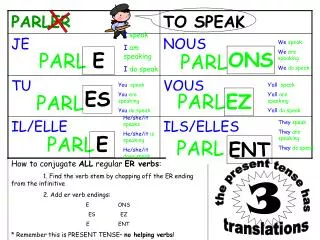
Verb conjugation JE PARL E NOUS PARL ONS TU PARL ES VOUS PARL EZ IL/ELLE/ ON PARL E ILS/ELLES PARL ENT
-ER VERBS ARE FUN AND YOU CAN DO THEM TOO!!! • How would you conjugate… • danser • chanter • écouter
What do they mean?! • -er verbs are translated into the present tense. • When the verb is in its infinitive form, it is translated with as “to ---” • example: parler = to speak • When the verb is conjugated, it translates in one of two ways: “am/are/is ---ing” or “---” • example: je parle = • I am speaking or • I speak
What do these mean? • Tu danses • Nous parlons • Elles goûtent • Vous préférez • Je marche • Il chante



![How to conjugate the irregular verb [in the present tense]](https://cdn3.slideserve.com/6854857/how-to-conjugate-the-irregular-verb-in-the-present-tense-dt.jpg)