Understanding the Value of Ecosystem Services: A Multidimensional Approach
This document presents an overview of the complex nature of valuing ecosystem services (E-S-S), emphasizing both economic and ethical dimensions. It explores the concept of "value," addressing intrinsic and extrinsic motivations for ecosystem protection, such as the Endangered Species Act (ESA). It details the Total Economic Value (TEV) framework, distinguishing between use values (recreation, fishing) and non-use values (existence values). The text reviews various valuation methods, insights on measuring willingness to pay (WTP) and willingness to accept (WTA), and the analytical challenges of integrating ecological and economic assessments.

Understanding the Value of Ecosystem Services: A Multidimensional Approach
E N D
Presentation Transcript
Valuing Ecosystem Services Geoffrey Heal for EPA-SAB
What is “value”? • Multidimensional • Many aspects of the value of e-s-s • Includes a range of ethical sources of value as well as economic aspects of value – • “Intrinsic value” or Kantian imperatives may be motivation for legislation as with the ESA • Focus on economic aspects of value
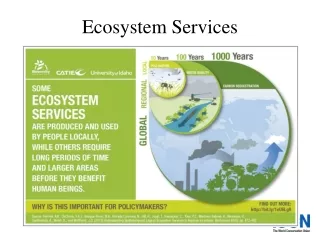
Total Economic Value • TEV – • Use and non-use values • Use values include recreation, fishing, water purification • Non-use values include existence values • Quite comprehensive – more that generally recognized by non-economists
Classification of Total Economic Values for Aquatic Ecosystem Services SOURCE: Adapted from Barbier et al., (1997) and Barbier (1994).
Valuation methods • Market methods, revealed preferences – relatively rare (non-market, public goods) • Non-market methods, stated preferences • Travel costs • Hedonics • Stated preference methods – • Contingent valuation and conjoint analysis
What to measure • Willingness to pay or • Willingness to accept • Depends primarily on property rights, expectations • WTA > WTP, which is bounded by income while WTA is not
Measurement • We are always interested in measuring the values of changes in e-s-s that will result from human activities • The focus is on changes in e-s-s from human activities and on • Valuing the changes in e-s-s
Difficulty • Main analytical difficulty seems to be in linking economic and ecological analyses • Need to use ecological analysis to predict response of e-s-s to human activities • Ecologists tend to focus on impact of human actions on ecosystem structure and function
Difficulty • Need ecologists to predict D(e-s-s) resulting from policy measures • Is often complex and stretches science to the limits • Then use economics to value (as WTA or WTP) this D(e-s-s) by a suitable valuation method