Download
1 / 7
70 likes | 210 Views
This guide provides a detailed analysis of magnesium hydroxide and ammonia in aqueous solutions. It begins with magnesium hydroxide (Mg(OH)2) to determine its base strength, concentration, hydroxide ion concentration, and pH. We then shift focus to ammonia (NH3), calculating its concentration, setting up the Kb equation, and finding the resultant hydroxide ion concentration and pH. Finally, we explore the hydrolysis of salts, particularly regarding aluminum nitrate (Al(NO3)3), including a chemical reaction demonstration, acid-base strength, and pH assessment.

E N D
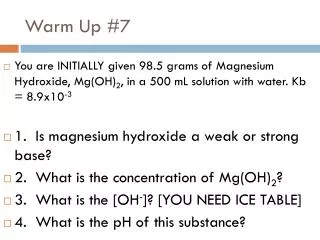
Warm Up #7 • You are INITIALLY given 98.5 grams of Magnesium Hydroxide, Mg(OH)2, in a 500 mL solution with water. Kb = 8.9x10⁻³ • 1. Is magnesium hydroxide a weak or strong base? • 2. What is the concentration of Mg(OH)2? • 3. What is the [OH-]? [YOU NEED ICE TABLE] • 4. What is the pH of this substance?
Warm Up #7 10 grams NH3, a weak base, reacts with water to make a 5 L solution at equilibrium. The Kb of NH3 is 1.8x10⁻⁵ • Calculate [NH3]…M = mol/L • Show the reaction between NH3 and water, and set up a Kb equation. • Solve for the [OH-]. With this, solve for the pH of your base.
Chapter 19.5 Hydrolysis of a Salt
Hydrolysis…what? • Hydrolysis – adding water • When adding water to a salt you get… • One acid • One base • Ex. NaCl + HOH NaOH + HCl • NaOH = base, HCl = acid • DOUBLE REPLACEMENT
Strong Acids and Bases • Strong Acids: HCl, HBr, HI, HNO3, HClO3, H2SO4 • Strong Bases: Any Alkali/alkaline metal with OH (except Mg)
pH of the Salts • Strong acid and Strong base • NEUTRAL pH • Strong acid and Weak base • ACIDIC pH • Weak acid and Strong base • BASIC pH • Weak acid and Weak base • UNKNOWN pH
Warm Up #9 You add water to Al(NO3)3: • Show this chemical reaction, and balance the equation. • On the products side, label the acid and the base (including their names). Also, include the strength of each (weak/strong). • What will the pH of this salt be (acidic/basic)? How do you know?