Download
1 / 4
40 likes | 159 Views
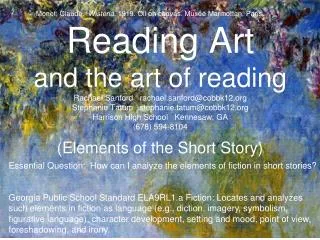
Monet, Claude. Wisteria. 1919. Oil on canvas. Musée Marmottan, Paris. Reading Art and the art of reading Rachael Sanford rachael.sanford@cobbk12.org Stephanie Tatum stephanie.tatum@cobbk12.org Harrison High School Kennesaw, GA (678) 594-8104. (Elements of the Short Story).

E N D
Monet, Claude. Wisteria. 1919. Oil on canvas. Musée Marmottan, Paris. Reading Artand the art of readingRachael Sanford rachael.sanford@cobbk12.org Stephanie Tatum stephanie.tatum@cobbk12.org Harrison High School Kennesaw, GA (678) 594-8104 (Elements of the Short Story) Essential Question: How can I analyze the elements of fiction in short stories? Georgia Public School Standard ELA9RL1.a Fiction: Locates and analyzes such elements in fiction as language (e.g., diction, imagery, symbolism, figurative language), character development, setting and mood, point of view, foreshadowing, and irony.
Matisse, Henri. The Music Lesson. 1917. Oil on canvas. Barnes Foundation, Lincoln University, Merion, PA, USA. Based on what you see in this work, what do you imagine about what was happening immediately before this moment? What details support your conjecture? What do these details tell you about the setting of the painting? How does the artist emphasize these details to show their importance?
Imagine you are writing a short story inspired by this painting. Write the opening paragraph that would explain the setting and background information. Using descriptive words, capture the same images the artist captures on canvas. Also, imitate the mood that seems evident in the scene. Henri Matisse. The Music Lesson. 1917. Oil on canvas. Barnes Foundation, Lincoln University, Merion, PA, USA.
Henri Matisse. The Music Lesson. 1917. Oil on canvas. Barnes Foundation, Lincoln University, Merion, PA, USA. Exposition You have just written an exposition—or introduction to the setting, situation, and main characters of the plot. Share your exposition with a neighbor. What differences occur between your two renditions?