Unveiling the Fascinating Realm of Roundworms
380 likes | 524 Views
Explore the world of roundworms, versatile creatures living in diverse environments with intriguing biology, habits, and parasitic tendencies. Understand their anatomy, life cycles, and impact on various hosts.


Unveiling the Fascinating Realm of Roundworms
E N D
Presentation Transcript
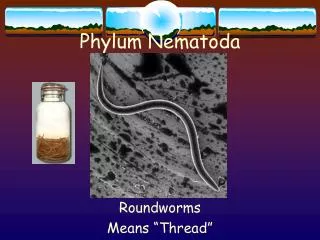
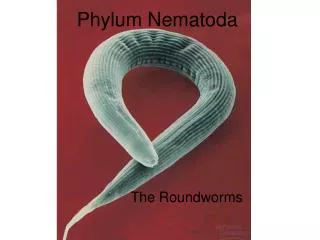
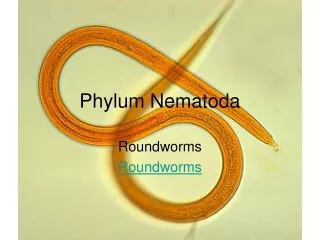
Phylum Nematoda Roundworms Roundworms
Taxonomy Kingdom Animalia Phylum Nematoda Class Secernentea Class Adenophorea Filarial worms Trichinella worm Roundworms Hookworms Pinworms
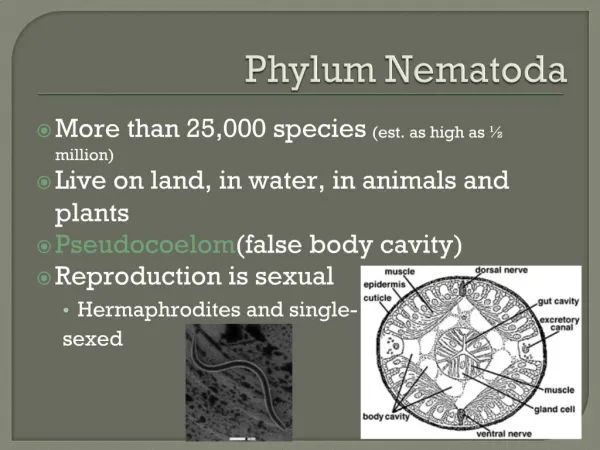
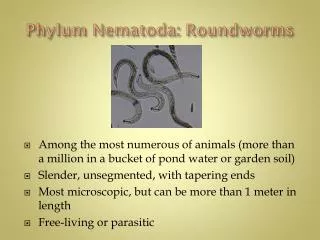
General Characteristics • Live in fresh and salt water, soil and inside organisms • Live in every habitable environment • Over 8,000 named species • Parasites to many plants and almost every type of animal • Pseudocoelomate: false body cavity • Straight-through digestive tract with 2 openings
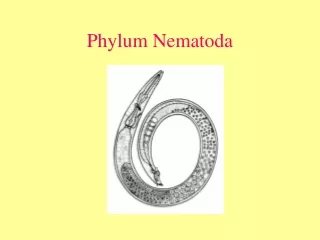
Form and Function • BodyPlan: Pseudocoelom • Threelayers: Epidermal (cuticle) layer, muscle layer and gut cavity • The pseudocoel is fluid-filled and holds reproductive organs
Form and Function • Epidermis: thick cuticle layer for protection • Hydrostaticskeleton: a fluid-filled, pressurized cavity surrounded by muscle
Digestion • DigestiveSystem: Consists of a mouth, pharynx (throat), an intestine, a rectum and an anus • One way straight path
Circulation and Respiration • Circulation: No circulatory system: Cells circulate nutrients and gases • Respiration: Gas exchange occurs through diffusion through cuticle • Sensoryorgans: 2 nerve cords (ventral and dorsal)
Movement • Movement: move by muscle contractions and cilia (tiny hairs)
Reproduction • Most are dioecious • Fertilization is internal • Males have a spicule to grab on to the female while mating • Shelled fertilized eggs are stored in the uterus until they can be deposited in the soil • One female can lay up to 200,000 eggs in one day
Life Cycle Stages • 4 juvenile stages with molting occurring between stages • Some stages require an intermediate host
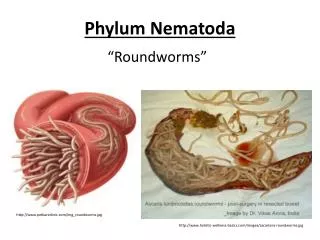
Class Secernentea: Roundworms • Most common worm parasite in humans • Live in Tropical areas with poor sanitation • Eggs can survive for years in soil (unhatched) • Contracted by eating vegetables from infected soil • Lives in the intestines of the host but can migrate to the heart, lungs or brain • roundworm parasite in toddler
Class Secernentea: Hookworms • Transmitted through the soil • Either ingested or can burrow through the skin • Attach to the intestinal wall and suck more blood than they need • Can lead to high amounts of blood loss • parasite from cat scratch
Pinworms • The most common parasite in the U.S. • Contracted through ingestion or anally • Adults live in large intestine • Live in intestines but migrate to the anus at night to lay their eggs
Filarial Worms • Most common is the heartworm in dogs • Enters tissues and causes immense swelling (elephantitis) • Transmitted into blood stream through mosquitoes
Class Adenophorea: Trichinella Worm • Cause the potentially lethal disease trichinosis • They are found in almost any body tissue • Transmitted by eating uncooked pork or other infested meat • Infect a wide range of mammals • trichinosis • monsters inside me