Call to Order
The assassination of Archduke Franz Ferdinand on June 28, 1914, triggered a cascade of events leading to World War I. Austria-Hungary declared war on Serbia, prompting various European countries to take sides influenced by nationalism, imperialism, and militarism. As alliances formed, the Central Powers (Austria-Hungary, Germany, Ottoman Empire, Bulgaria) clashed with the Allied Powers (Serbia, Russia, France, Great Britain, Italy, and others). Notable events such as the Zimmerman Telegram and the sinking of the Lusitania escalated tensions, showcasing the complex factors that led to a devastating global conflict.

Call to Order
E N D
Presentation Transcript
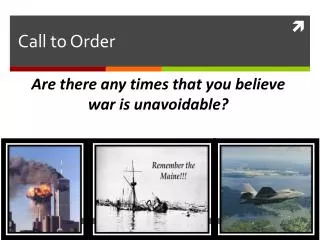
Call to Order Are there any times that you believe war is unavoidable?
Assassination of Archduke Ferdinand • On June 28, 1914, Austria Hungary’s Archduke Franz Ferdinand was assassinated. • Austria-Hungary declared war on Serbia • European countries begin to take sides
Nationalism • Countries had a lot of pride • Some countries wanted to fight for their own freedom • Other countries wanted to dominate them
Imperialism • Britain, France, Germany, and Italy competed for colonies in Africa and Asia
Militarism • Trench Warfare = Troops huddled at the bottom of rat-infested trenches • U-Boats = German submarines that blocked trade
Alliances • Central Powers = Austria-Hungary, Germany, the Ottoman Empire, and Bulgaria • Allied Powers = Serbia, Russia, France, Great Britain, Italy, and seven other countries • Zimmerman Telegram = a message sent from the German foreign minister to Mexico, asking Mexico to join the Germans and Germany would help Mexico fight to win back Texas, New Mexico, and Arizona from the United States
Lusitania • In May 1915, a German U-Boat torpedoed the British passenger ship Lusitania, killing 1,198 people, including 128 Americans.