Understanding Kinematics: Key Variables and Equations of Motion
Kinematics describes the motion of objects without addressing the causes. We can illustrate motion using words, mathematics, pictorially, or graphically. Several key variables define this motion. The three primary kinematic equations apply when acceleration is constant. Through real-world examples, such as boats and cars, we illustrate how to determine speed, distance, and time in various motion scenarios. Common student difficulties include choosing the correct equation for problems involving acceleration. This overview serves as a guide to understanding these concepts effectively.

Understanding Kinematics: Key Variables and Equations of Motion
E N D
Presentation Transcript
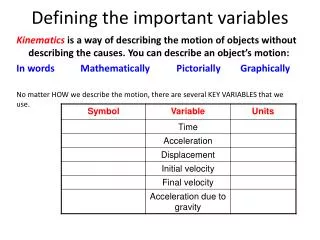
Defining the important variables Kinematics is a way of describing the motion of objects without describing the causes. You can describe an object’s motion: In words Mathematically Pictorially Graphically No matter HOW we describe the motion, there are several KEY VARIABLES that we use.
The 3 Kinematic equations There are 3 major kinematic equations that can be used to describe the motion in DETAIL. All are used when the acceleration is CONSTANT.
Example #1 Example:A boat moves slowly out of a marina (so as to not leave a wake) with a speed of 1.50 m/s. As soon as it passes the breakwater, leaving the marina, it throttles up and accelerates at 2.40 m/s2. a) How fast is the boat moving after accelerating for 5 seconds?
Example #1 Continued b) How far did the boat travel during that time?
Example #2 Example:You are driving through town at 12 m/s when suddenly a ball rolls out in front of your car. You apply the brakes and begin decelerating at 3.5 m/s2. How far do you travel before coming to a complete stop?
Common Problems Students Have I don’t know which equation to choose!!!
Examples How long does it take a car at rest to cross a 35.0 m intersection after the light turns green, if the acceleration of the car is a constant 2.00 m/s2?
Examples A car accelerates from 12.5 m/s to 25 m/s in 6.0 seconds. What was the acceleration?
Examples A stone is dropped at rest from the top of a cliff. It is observed to hit the ground 5.78 s later. How high is the cliff?
Examples A pitching machine throws a fastball with a velocity of 15.0 m/s. The ball is inserted into the back of a tube that has a length of 1.25 meters. The ball is “fired” out of the other end towards the batter. How much time elapses from the time the ball is inserted in one end of the tube until it is fired from the other end?