Download
1 / 13
130 likes | 238 Views
This overview explores the three main types of muscles in the human body: skeletal, cardiac, and smooth muscles. Skeletal muscles are voluntary, striated, and attached to bones, enabling movement and posture support. Cardiac muscles are involuntary, striated, and found only in the heart, facilitating blood circulation. Smooth muscles, also involuntary, lack striations and are responsible for peristalsis in hollow organs. Each muscle type plays a vital role in bodily functions, including movement, posture maintenance, joint stabilization, and heat generation.

E N D
Overview Myo- Mys- Sarco-
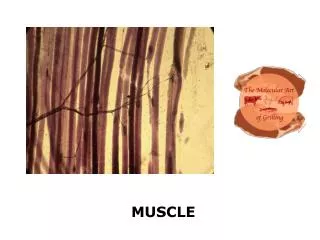
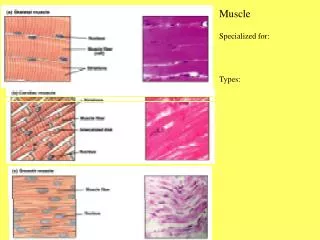
Striations Elongated cells Attach to cover the skeleton Power Voluntary skeletal, striated, voluntary Skeletal Muscle
Striated Branched Heart Involuntary Gap junctions cardiac, striated, involuntary Cardiac Muscle
No striations Walls of hollow visceral organs Involuntary Peristalsis visceral, nonstriated, involuntary Smooth Muscle
Muscle Functions #1: Producing Movement • Skeletal = locomotion and manipulation • Cardiac = movement of blood through heart. • Smooth = squeezes substances through organ tracts.
Muscle Functions #2 Maintaining Posture
Muscle Functions #3 Stabilizing Joints
Muscle Functions #4 Generating Heat
Muscle Characteristics #1 Excitability or Irritability • Ability to receive and respond to a stimulus.
#2 Contractility - Ability to shorten forcibly when stimulated
#3 Extensibility • Ability to stretch or extend
#4 Elasticity Ability to resume resting length after being stretched