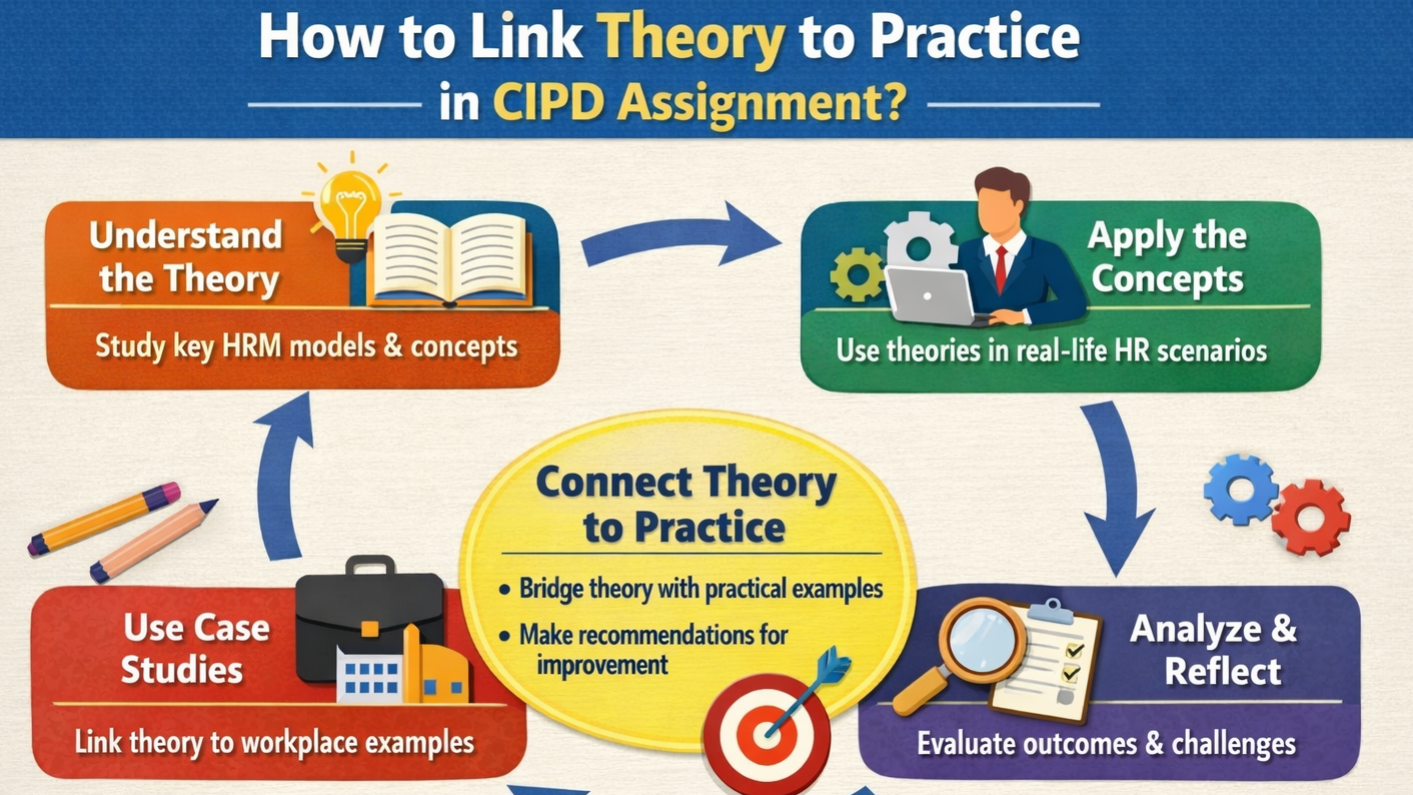
You can study the methods to link your theories with the practical world from this guide. Moreover, it is vital to connect your theories with the practical world to excel in your CIPD assignments. Because it is not enough to define HR concepts, you actually need to explain how they solve real-world business problems. Also, keep yourself connected with the academic models and find a CIPD professional map to prove your expertise. If you need support, find the best CIPD assignment help from expert sites to ensure that your work is professional and practical. Let’s start with the stepwise article. Read carefully.
Stepwise Guide on Linking Theory to Practice in Your Assignment
You need to show how textbook ideas help you to solve real-life problems to pass your CIPD assignments. It proves that you don't only memorise facts, but you actually know how to use them to help your company and its people. It means you are linking theory to practice. This guide gives you a simple, step-by-step plan to connect your learning to your daily job. Following these steps will help you write a professional paper that meets high CIPD standards.
Step 1: Understand the Assignment Question and Context
The first and most vital step to produce a high-quality CIPD assignment is to make sure that you have a complete understanding of the task. Also, various students rush straight into the writing part without actually breaking down the instructions. Thus, it leads you towards the wrong or incomplete answers.
Identify the Command Words: You need to pay attention to the action verbs such as "analyse", "evaluate", etc. These words define the depth and the complexity of your required answer. Misinterpreting these words is a common reason for losing marks.
Define the Scope: Pin down the specific theories, topics, and scenarios relevant to your task. Clarify whether you should be drawing examples from your current workplace, a past job, or a general industry case study provided by your study centre.
Clarify Learning Outcomes: Understand which specific learning outcomes from the CIPD unit you are addressing. It helps you tailor your answer to meet the required assessment criteria from the outset, guaranteeing that your work aligns with the CIPD's professional standards.
Step 2: Select and Summarise the Relevant Theory
The next critical step after understanding the requirements of the assignment question and the specific context you need to discuss you need to identify and outline the relevant academic models. These will support your analysis. Also, this stage requires you to demonstrate foundational knowledge of the subject matter and establish the theoretical basis for your later application to practice.
Choose the Right Theories: Choose well-known HR or L&D ideas and models. If you want, you can also explore Assignment Desk services for the same. For example, use a theory about motivation if you are writing about engaging staff. Also, you need to make sure that you use reliable data.
Explain the Theory: Write a summary of the theory using clear, formal language. You need to show you understand how the idea works before you use it in your scenario. Don't copy long paragraphs from books; put the perspective into your own words and mention where it came from using the correct referencing style.
Step 3: Introduce Your Real-World Practice/Scenario
When you select and summarise the academic theories relevant to your assignment, you ground your work in practical reality. Thus, professional qualifications require you to show how theories work in actual working environments. Further, this stage is about properly setting up the real-life example you will use for your analysis. Ensure you maintain integrity and privacy, for instance, by anonymising company names.
Describe the Context: Clearly describe the specific situation, project, or challenge you are drawing from. It can be from your current workplace, an experience, or a detailed industry example. Provide only enough background data for the reader to understand the situation without getting lost in extra detail.
Identify the 'Problem' or 'Situation': You need to state what happened, what decisions were made, or what specific challenge exists in this scenario. It provides the precise foundation for the analysis that follows a clear link to the theory you summarised.
Step 4: Critically Apply the Theory to the Practice
It is the part where you stop telling a story and start to act like an expert. You take the theory you chose and hold it up against what happened at work to see if they match. Also, the theory says employees need praise to work better, and the boss never gives praise, so you point out why your team is unhappy.
Don’t just tell a story: Don't only list what happened. Use the theory to explain the reasons behind the events.
Use the "Mirror" Technique: Match a specific part of the theory to a certain thing you did at work, for example, link "Team Training" to a particular model.
Find what was missing: Use the theory to show what your company forgot to do or what went wrong.
Use Connecting Words: You can use easy phrases such as "This matches..." or "This is different from the theory because..." to connect your thoughts.
Be professional: Don't get emotional about your job. So, stay calm and use formal language.
Add Citations: Every time you talk about a theory, put the author’s name in brackets. Check the Harvard in-text referencing generator for help.
Step 5: Evaluate the Outcome and Impact
After you have linked the theory to your job, you need to look at the final results and decide how successful they were. In 2026, the CIPD wants to see that you can judge if an HR action actually worked in real life. Thus, it means you need to look at what happened after the changes were made and explain the effect they had on the business and the staff.
Show the results using proof: Don’t just say the change was "good"; use simple facts or feedback to show if the company reached its goals and helped the workers.
Look at both sides of the impact: A great answer shows both the successes and the struggles, explaining how the outcome affected different people, like managers and staff.
Step 6: Conclude and Reflect
It is the final stage of your assignment, where you put all of the data you've learned. Also, the CIPD gives high importance to the reflective practice, so you can look back at the situation and think about improvements. However, this section shouldn't only repeat the previous statements, but it should focus on the lessons and next steps for your career.
Summarise your main findings and lessons: Briefly restate if the theory helped explain the workplace situation, and list the most important things you discovered during your analysis.
Give clear advice for the future: Suggest simple, practical changes the company could make next time based on what you found, ensuring your ideas match the CIPD Profession Map standards.
Reflect on your own growth: Explain how this experience has changed the way you think about HR. Plus, describe what you will do differently in your own job to be more effective.
Conclusion
The link between theory & practice is the key to becoming a successful HR professional. Follow this stepwise guide, and you move away from simply telling stories and start providing expert analysis. Always remember to use the "mirror" technique to match models to your actions and look for gaps where things could improve. Also, the best CIPD assignment help through reflection helps you grow & prepares you for future challenges. Use these steps to ensure your work meets the high standards of the CIPD Profession Map and shows your value to any organisation.