Comprehensive Guide to Powers, Fractions, Coordinates, Angles, and Geometry
120 likes | 257 Views
This guide covers essential mathematical concepts including powers, fractions, and coordinate systems. Learn how to calculate powers using a calculator and apply rules for multiplying and dividing powers. Understand fractions, including adding, subtracting, and dividing them. Explore 3D coordinates, find midpoints, and utilize bearing measurements. Discover calculations for area and volume of various shapes, and master expanding and factorizing brackets, as well as plotting straight lines. Improve your geometry skills with key circle angle principles.


Comprehensive Guide to Powers, Fractions, Coordinates, Angles, and Geometry
E N D
Presentation Transcript
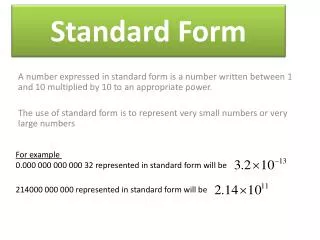
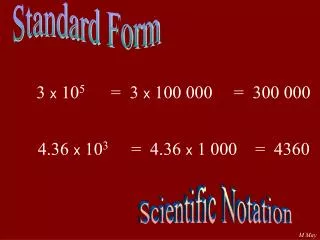
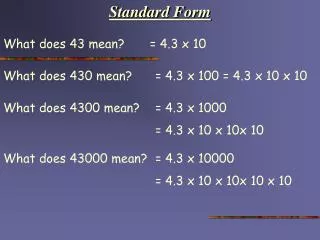
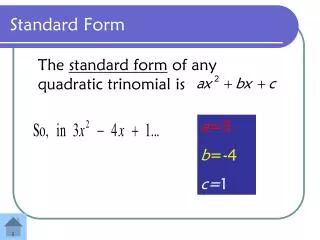
STANDARD FORM It’s a number between 1 and 10 times by a power of 10. e.g. 450 is 4.5 x 10² Use the exp button on the calculator
POWERS • Add the powers when multiplying • Take away when dividing • Power of 0 is 1 • Fraction powers: ½ is square root, 1/3 is cube root • Negative powers are 1 over the positive power
FRACTIONS • Fraction of – divide by the bottom, times by the top. • Add, subtract – make the bottoms the same • Divide – turn the 2nd fraction upside down and times
COORDINATES • For 3d coordinates follow the axes as x,y,z • To find midpoints add the x’s then halve. Do the same for the y’s and z’s.
ANGLES • Parallel lines- the FUZ is the CIA • Bearings measure clockwise from North
LCM and HCF • LCM is a multiple, so is bigger than the start numbers • HCF is a factor, so is smaller than the start numbers
AREA • Rectangle is length x width • Triangle is height x base / 2 • Trapezium is (add parallel sides) x height /2 • Compound shapes – split into easier shapes then add together
VOLUME • Prisms – Area of front x length
EXPANDING BRACKETS • Two brackets together – eyebrows and smiley face are 4 multiplies
FACTORISING BRACKETS • Pick the x’s to times together • Pick the numbers to times to the question • Check the smiley face to see if the x term is right
STRAIGHT LINES • Form is y=mx+c • To plot the line, take 3 • x values and find out the y values that go with them
CIRCLE ANGLES The angle between a tangent and a radius is 90o