Download

1 / 16
160 likes | 271 Views
This study aims to explore the performance of various financial factors during different stages of the economic cycle. By developing a time-varying multifactor strategy, we assess how factors like Book-to-Price, Price Momentum, and Free Cash Flow Yield can outperform the market across liquidity regimes: Calm, Speculation, Turbulence, and Rebound. Our results indicate that while stable strategies yield higher alpha, the cycle-varying strategy demonstrates consistent performance against market fluctuations, achieving positive alpha without significant losses even if turning points are missed.

E N D
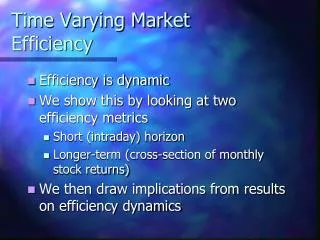
Market Cycle Varying Multifactor Strategies Cyclical Analysts Noah Harris Juliet Xu JJ Haines
Goal • To determine whether or not different factors behave better or worse during different stages of the economic cycle. • To develop a time-varying multifactor strategy to take advantage of these differences in factor behavior.
Agenda • Overview • Factors • Market Cycles • Scoring Screens • Results • Conclusions
Overview • Identify successful factors from Global Asset Allocation final projects • Run in- and out-of-sample screens for all factors (monthly) • Use historical data from a pre-determined four-stage cycle to segment factor returns • Regress macroeconomic data to predict next month’s cycle stage
Factors • We looked at the best factors used by the groups from Global Asset Allocation. • Selected Factors: • Book to Price • Analyst Estimate Revision • Price Momentum • Free Cash Flow Yield (FCF/P) • NTM Forward Earnings to Price • Fundamental Debt Factor – eliminated due to poor in-sample performance
Market Cycles • Defined by four liquidity regimes: • Calm = positive increasing • Speculation = positive decreasing • Turbulence/Crisis = negative decreasing • Rebound/Recovery= negative increasing (where positive/ negative refers to the liquidity environment)
Scoring Screens and Factor Weightings for Different Cycles Factors are scored from -5 to 5 by each teammate and averaged Long Weightings sum to 100%, Short Weightings sum to -100% “Total” represents weights for a non-varying multifactor scoring screen
Strategy Performance-Annual The stable screen had the best out-of-sample performance for both long only and long-short but the cycle varying screen beat the S & P more often in long only. Cycle Varying- Scoring screens vary with market cycle Equal Wt Factors Varying- Scoring screens vary with market cycle & factors are equal weighted Stable-Scoring screen stays constant through all periods
Strategy Performance-Cycles Both the Cycle Varying and Stable Long Only strategies beat the S & P in all four market cycles. The Cycle Varying Long-Short beat the S & P in 3 out of 4 cycles.
Mistiming Question:What happens if we miss the turning point from one regime and the next? • Check returns out-of-sample assuming that we miss the turning point by 1, 2 or 3 months • The results show that there is little or no significant loss in Alpha!
Prediction for Next Period: Prediction:Next Period will be CALM Procedure: • Use Logistic Regressions for each regime independently and compare results
Example of Predictive Process • Use all monthly data for final prediction • Use backward stepwise to optimize the number of variables (P-to-remove = 0.05) • Results in different final list of variables for each regime Example:Test for Calm
Conclusions • Using the cycle varying strategy adds positive alpha • The stable investment strategy outperforms the cycle varying strategy out-of-sample • While both our stable and cycle varying strategies performed well, the stable strategy performed better for long-short and long only and had higher alphas • Our cycle varying strategy had more consistent performance, beating the market in 7 out of 8 years, but was not clearly able to add alpha or returns over a stable strategy • Best Strategy (highest alpha): Buy the long-short stable investment portfolio • Regimes are based on regressions, and therefore highly predictable • Missing a regime change by up to 2 months is does not seriously impact portfolio performance
Recommendations for Further Study • Determine which factors specifically failed out of sample • Select less correlated factors • Try to identify better performing regime definitions of the economic cycle • Determine whether varying weights and factors in different regimes adds significant costs • Does it cost more to vary the weights or the factors?