Download
1 / 14
140 likes | 263 Views
This guide explains how to find the Least Common Denominator (LCD) of various equations and solve them step by step. It includes multiple examples such as finding LCD for expressions, solving rational equations, and checking for extraneous solutions. Through clear instructions, mathematical expressions are simplified, and important concepts are demonstrated, helping you strengthen your algebra skills. Ideal for students seeking to improve their understanding of rational expressions and equation solving techniques.

E N D
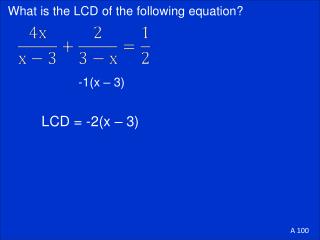
What is the LCD of the following equation? -1(x – 3) LCD = -2(x – 3) A 100
After you multiply by the LCD, what is the resulting equation? LCD = 6x(x – 2) 2(x + 2)(x – 2) – 2x(6x) = x(x – 1)(x – 2) A 200
Solve 9(x – 3) = 3(x + 5) 9x – 27 = 3x + 15 6x = 42 x = 7 A 300
Solve + = + = LCD = 2x 1 + 2(2x – 3) = 2(2) 1 + 4x – 6 = 4 -5 + 4x = 4 4x = 9 x = 9/4 A 400
Solve LCD = (a-1)(a+1) a(a – 1)(a + 1) + a2 – 5 = (a2 + a + 2)(a – 1) a(a2 – 1) + a2 – 5 = a3 – a2 + a2 – a + 2a – 2 a3 – a + a2 – 5 = a3 + a – 2 a2 – 2a – 3 = 0 (a – 3)(a + 1)= 0 a = 3 (-1 is extraneous) A 500
What is the fully factored LCD of the related equation for this inequality? - < - < LCD = 8(x + 1)(x – 1) B 100
When you solve the related equation below, the answers are x = 2 and x = 3. What is the final answer? x = 2, x = 3, x ≠ 0 Test x = -1 T x = 1 F x = 2.5 T x = 4 F x < 0 or 2 ≤ x ≤ 3 0 2 3 B 200
Solve LCD = 6(x – 1) 6(x – 1) + 5(6) = 7(x – 1) 6x – 6 + 30 = 7x – 7 6x + 24 = 7x – 7 31 = x x ≠ 1 Test x = 0 T x = 2 F x = 32 T x < 1 or x ≥ 31 1 31 B 300
Solve x2 – 7x + 12 = 0 (x – 3)(x – 4) = 0 x = 3, 4 x ≠ 5, 6 Test x = 0 T x = 3.5 F x = 4.5 T x = 5.5 F x = 7 T x < 3 or 4 ≤ x ≤ 5 or x > 6 3 6 5 4 B 400
Solve LCD: 15(2x + 1)(x + 1) 15(x + 1) + 15(2x + 1) = 8(2x + 1)(x + 1) 15x + 15 + 30x + 15 = 16x2 + 24x + 8 0 = 16x2 + 21x – 22 0 = (16x + 11)(x – 2) x = -11/16 or 2 x ≠ -1/2 , -1 Test x = T x = 3.5 F x = 4.5 T x = 5.5 F x = 7 T x < 3 or 4 ≤ x ≤ 5 or x > 6 -1 2 B 500
Which two x-values would you use to decompose the following rational expression? (2x – 1)(x + 3) Use x = ½ and x = -3 C 200
What is the result after the first three steps of decomposing Factored LCD: (x – 1)(x + 2) = + 8x + 7 = A(x + 2) + B(x – 1) C 300
Decompose x(x – 5) = + 15x – 35 = A(x – 5) + B(x) x = 0: 15(0) – 35 = A(0 – 5) + B(0) A = 7 x = 5: 15(5) – 35 = A(5 – 5) + B(5) B = -5 = + C 400
Decompose (x – 2)(x + 2) = + 5x – 4 = A(x + 2) + B(x – 2) x = 2: 5(2) – 4 = A(2 + 2) + B(2 – 2) A = 1.5 x = -2: 5(-2) – 4 = A(-2 + 2) + B(-2 – 2) B = 3.5 = + C 500