Understanding VSEPR Theory and Resonance Structures for Molecular Shapes
This guide explores the Valence Shell Electron Pair Repulsion (VSEPR) theory, which helps predict molecular shapes by considering the repulsion between electrons surrounding a central atom. It discusses resonance structures, emphasizing that more than one Lewis diagram can represent the same compound, illustrating the concept with examples. Key steps for applying the VSEPR model include drawing the Lewis structure, counting the "things" attached to the central atom, and using a chart to determine molecular shapes. This knowledge is essential for understanding chemical bonding and molecular geometry.

Understanding VSEPR Theory and Resonance Structures for Molecular Shapes
E N D
Presentation Transcript
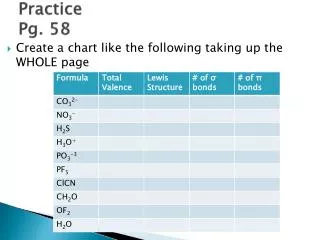
PracticePg. 58 • Create a chart like the following taking up the WHOLE page
VSEPR Theory Pg. 59
Resonance • It is possible to have more than one Lewis diagram for the same compound • Called resonance structure • Ex.
Molecular shape • You can determine the shape of a molecule based on the Valence Shell Electron Pair Repulsion model (VSEPR) • Electrons repel each other and determine shape • Bond angles are predicted using VSEPR
Steps for VSEPR model • Draw Lewis Structure • Determine the total number of “things” attached to central atom • Things includes bonds and lone pairs • A lone pair counts as 1 ‘thing’ • Double and triple bonds count as one thing • Use the chart to determine the molecular shape • Ex. CH4 and H2O
Pg. 60 • Attach a page to page 60 so that it is side by side with it. Make the following chart