Download
1 / 14
140 likes | 289 Views
This chapter delves into the kinematics of particles, exploring distance, velocity, and acceleration. It explains how to calculate average and instantaneous velocity through increments of distance and time. Detailed measurements at specific time intervals demonstrate the concepts, including derivatives relevant to motion. The chapter covers Cartesian and polar coordinate systems, including how to express motion in different dimensions. Readers will learn about radial, tangential, and angular velocities, as well as how to analyze the relative motion of particles.

E N D
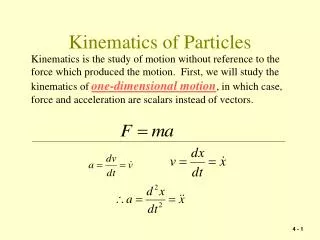
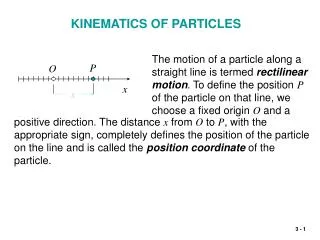
Chapter 3 Kinematics of particles Increment: distance traveled at the end of the 1st second = 10 m distance traveled at the end of the 3rd second = 14 m increment of distance = 4 m increment of time = 2 s Ratio between two increments = 4 m/2s = 2 m/s (average velocity) More detailed measurement: distance traveled at the end of 1.01 second, the distance traveled is 10.025 m, the ratio becomes 0.025 m / 0.01 s = 2.5 m/s (instantaneous velocity). Differentiation: the ratio between two increments when they are extremely small, e.g. velocity.
Position z Instantaneous velocity O y Acceleration x
z y x Cartesian coordinate system
2D Polar coordination system y : unit vector // to (radial) : unit vector to (in -direction) x O
y O x radial velocity angular velocity tangential velocity Velocity Since
Acceleration Since centripetal acceleration.
Solution
Solution For OAP, 0.082 = 0.042 +r2+2 x 0.04 r cos Time derivative: At = 90o, r = 0.06928 m P r 0.08m A O 0.04m
z z y x r 3D Cylindrical coordination system
radius of curvature O’ O’ Normal and Tangential Coordinates (n-t) :
Position of A relative to B : Velocity of A relative to B : Acceleration of A relative to B : y A B x o