The EC-Council 312-40 exam, commonly associated with Certified Ethical Hacker–level foundational security knowledge, is often attempted by professionals who are already working full-time in IT roles. For this audience, the primary challenge is not intellectual difficulty but time scarcity. Long study windows, unfocused preparation, and generic advice rarely align with the realities of production environments, on-call rotations, and competing responsibilities.
This article outlines a preparation strategy for the EC-Council 312-40 exam that is specifically designed for busy IT professionals. Rather than emphasizing volume, it focuses on efficiency, prioritization, and alignment with how the exam actually evaluates cybersecurity competence.
Understanding What the 312-40 Exam Prioritizes
The 312-40 exam does not reward deep specialization in a single security tool or technique. Instead, it evaluates whether a candidate understands the ethical hacking lifecycle as a structured process. Topics are distributed across reconnaissance, scanning, enumeration, exploitation awareness, and post-exploitation concepts, with strong emphasis on intent, methodology, and limitations.
For busy professionals, this means preparation should not mirror the depth required for hands-on penetration testing roles. The exam expects conceptual clarity, contextual understanding, and correct interpretation of scenarios rather than advanced exploit development or scripting expertise.
Recognizing this scope early prevents over-preparation in narrow areas and helps candidates allocate time where it produces measurable exam value.
Shifting From Study Hours to Study Outcomes
One of the most common mistakes busy professionals make is equating preparation quality with hours spent studying. In practice, outcome-driven preparation is far more effective. The goal is not to “cover” all topics exhaustively, but to ensure a reliable understanding of how and why techniques are used. An efficient strategy begins by identifying outcome expectations for each domain. For example, understanding why scanning precedes exploitation is more valuable than memorizing tool flags. This mindset allows candidates to compress study sessions into focused intervals that reinforce decision-making rather than recall. Busy schedules benefit from this approach because it replaces passive reading with deliberate learning tied to exam behavior.
Domain Prioritization Under Time Constraints
Not all exam domains carry equal cognitive load. Some areas require conceptual understanding, while others rely on recognition of terminology and ethical boundaries. Busy professionals should prioritize domains that require reasoning, as these are harder to compensate for late in preparation. Early focus should be placed on understanding attack phases, common vulnerabilities, and ethical constraints. These areas appear frequently in scenario-based questions and require synthesis rather than memorization. Domains that rely more on terminology can be reviewed later with lower time investment. This prioritization ensures that limited study time addresses high-impact areas first.
Leveraging Existing Professional Experience
Many candidates underestimate how much of the exam content overlaps with real-world IT exposure. Experience with system administration, networking, monitoring, or incident response often provides implicit understanding of attack surfaces and defensive behaviors.
Effective preparation involves mapping this experience to exam objectives. For example, understanding how misconfigurations occur in production environments can clarify vulnerability exploitation concepts. Recognizing how logs are used in operations can strengthen comprehension of detection and enumeration phases.
By anchoring study material to familiar professional scenarios, candidates reduce cognitive load and accelerate retention. For a fast overview, readers can refer to Cert Empire’s latest X (Twitter) post on the subject.
Short, Structured Study Sessions
Long, uninterrupted study blocks are unrealistic for most working professionals. The EC-Council 312-40 exam lends itself well to segmented preparation. Topics can be broken into discrete units that fit into short sessions without losing coherence.
A practical strategy involves scheduling focused sessions around single concepts, such as reconnaissance methods or access control weaknesses. Each session should aim to answer specific questions: what the technique is, when it is used, and what constraints apply. This structure allows candidates to make consistent progress without requiring extended downtime.
Using Practice Tests as Calibration Tools
Practice tests are essential for busy professionals, but only when used diagnostically. Their primary value lies in identifying weak areas and revealing how questions are framed, not in score chasing.
Early practice tests establish a baseline and expose domain imbalances. Later tests validate whether adjustments have improved reasoning consistency. Candidates should analyze incorrect answers to identify whether errors stem from misunderstanding intent, missing constraints, or confusing similar concepts.
Some preparation environments, including Cert Empire, organize EC-Council practice tests by domain to help candidates quickly identify where limited study time should be redirected.
Avoiding Over-Reliance on Tools and Commands
A common inefficiency in 312-40 preparation is excessive focus on tool-specific commands. While familiarity is useful, the exam rarely requires command-level precision. Instead, it tests understanding of purpose, sequence, and ethical boundaries. Busy professionals should therefore limit time spent on tool mechanics and invest more in understanding what each tool category is designed to accomplish. This shift aligns more closely with exam expectations and conserves preparation time. Recognizing this distinction prevents wasted effort on details that provide little exam leverage.
Managing Cognitive Fatigue and Retention
Preparation efficiency is not only about content but also about mental sustainability. Fatigue reduces comprehension and increases error rates, especially for professionals balancing work and study.
Spacing study sessions, revisiting concepts periodically, and avoiding last-minute cramming improve retention. Candidates should aim for steady familiarity rather than peak intensity. This approach reduces stress and improves confidence during the exam. Busy professionals benefit from treating preparation as a gradual conditioning process rather than a sprint.
Translating Exam Preparation Into Job-Relevant Insight
One advantage of structured preparation is that it reinforces job-relevant security thinking. Understanding attack methodologies improves defensive awareness, even for professionals not pursuing offensive roles.
Candidates who prepare effectively often report improved ability to assess risk, recognize weak configurations, and communicate security concepts within their organizations. This spillover benefit enhances the return on investment of preparation time. The exam thus becomes not just a credentialing step, but a framework for refining a security perspective. Readers can explore a step-by-step breakdown in Cert Empire’s recent YouTube upload.
Final Thoughts
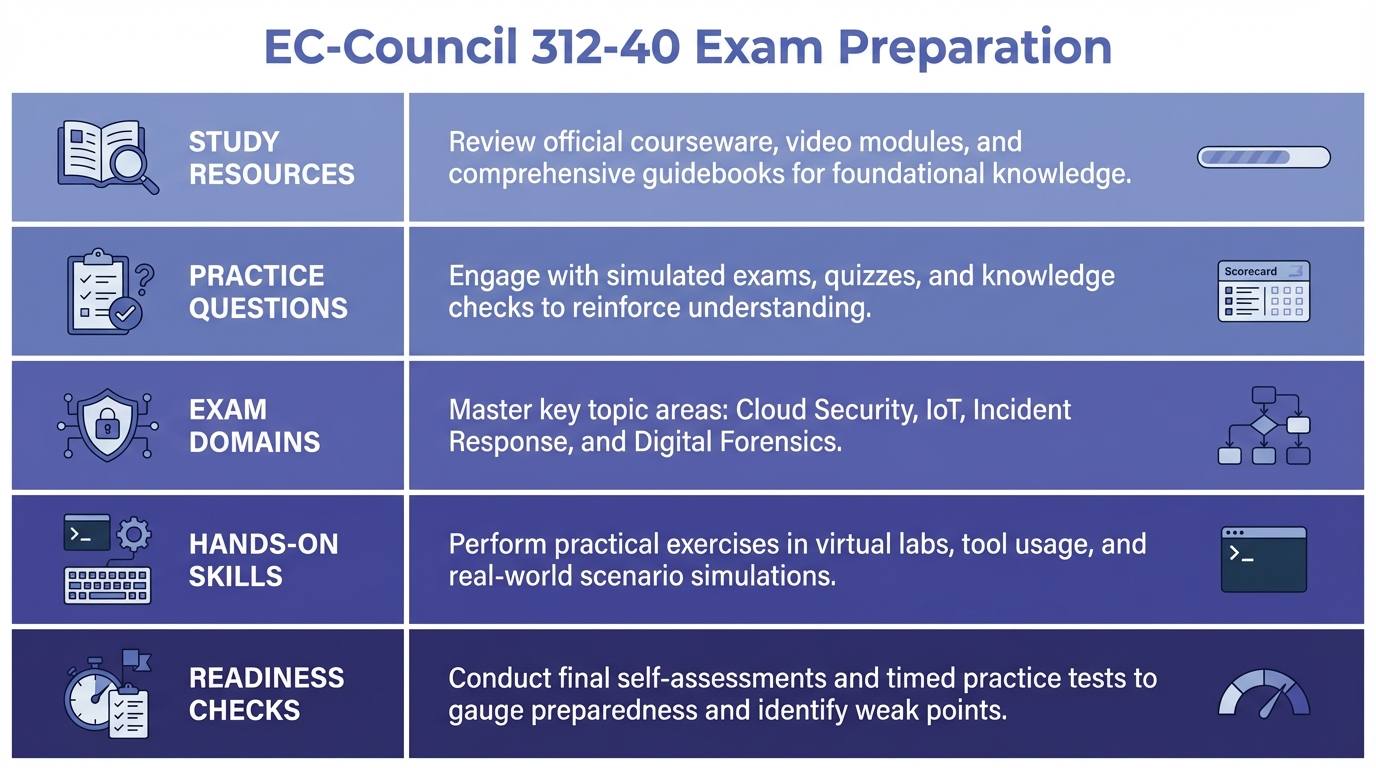
For busy IT professionals, passing the EC-Council 312-40 exam requires strategy rather than volume. The exam rewards structured understanding, contextual reasoning, and ethical awareness more than exhaustive technical detail. By prioritizing high-impact domains, leveraging existing experience, and using practice tests diagnostically, candidates can prepare efficiently without disrupting professional responsibilities.
When approached deliberately, exam preparation becomes a focused exercise in strengthening security reasoning rather than a time-consuming checklist. This balance is what enables busy professionals to succeed without compromising their work commitments.