Download
1 / 1
20 likes | 184 Views
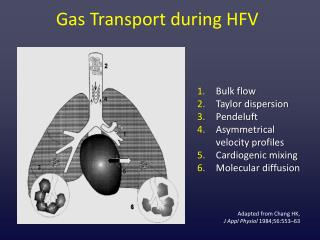
This article delves into the mechanisms of gas transport during High-Frequency Ventilation (HFV), highlighting key concepts such as bulk flow, Taylor dispersion, pendeluft, and asymmetrical velocity profiles. It further examines the role of cardiogenic mixing and molecular diffusion in enhancing gas exchange efficiency. Key insights are adapted from Chang HK’s research published in the Journal of Applied Physiology (1984). The intricate dynamics of these processes are critical for optimizing respiratory therapies and understanding pulmonary physiology.

E N D
Gas Transport during HFV • Bulk flow • Taylor dispersion • Pendeluft • Asymmetrical velocity profiles • Cardiogenic mixing • Molecular diffusion Adapted from Chang HK, J ApplPhysiol1984;56:553–63