COMEDY
"Caesar and Cleopatra" by George Bernard Shaw is a captivating play that delves into social behaviors and human vices, exposing the discrepancies between appearances and reality. With a complex plot filled with obstacles, mistaken identities, and misunderstandings, the story begins with a problem and culminates in resolution. The play serves an instructive purpose, offering comic relief rather than catharsis, while reflecting on the evolution of comedy through history, from its ancient Greek roots to modern genres.

COMEDY
E N D
Presentation Transcript
COMEDY Caesar and Cleopatra By Bernard Shaw
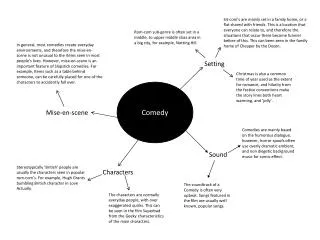
Focuses on people’s social behaviour. • Exposes and unmasks human weaknesses and vices. • Explores the discrepancy between the seeming and the real. • Starts with a problem, ends with its resolution. • Depends on a complicated plot (obstacles, confused identities, misunderstandings). • Instructive by nature and purpose. Comic relief instead of catharsis COMEDY
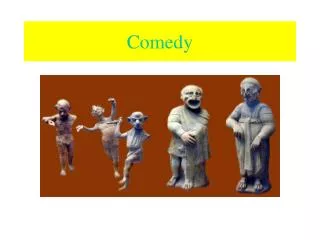
History of Comedy • Originated in Greece, 4th cent. BC. • First comedies (“Old Comedy”) were bawdy social satires. Aristophanes, “the father of comedy.” • Later, “New Comedy” formed the love-meets-obstacles model.
Main Genres of Comedy • Farce (ex., commedia del arte) • Romantic comedy • Comedy of humours • Comedy of manners These types can be mixed together within one dramatic work.
Types of Comedy • “Low comedy” appeals to baser sense of humour (farce, slapstick comedy). • “High comedy” appeals to intellect (romantic comedy; comedy of humours; comedy of manners).
Brief Historyof English Comedy • Farcical elements in medieval mystery and morality plays (The Second Shepherds’ Play); • Renaissance comedy (Shakespeare, Ben Jonson); • Restoration comedy of manners (William Congreve, Aphra Behn).
Brief Historyof English Comedy • 18th cent. sentimental comedy (Richard Steel) and comedy of manners/humours (Oliver Goldsmith); • 19th cent. comedy of manners (Oscar Wilde); • 20th cent. black/dark/absurd comedy (Samuel Beckett, Harold Pinter).
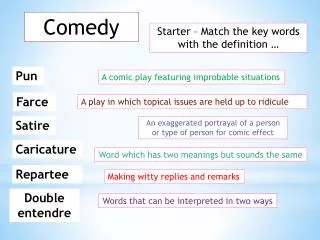
Elements of Comedy • Slapstick humour • Situational humour; qui pro quo. • Satire. • Verbal humour.
George Bernard Shaw (1856-1950) • Irish playwright, writer, critic, journalist, social activist. • The only person to have received both the Nobel prize and an Oscar. • Famous for “Shavian” witticisms. • Co-founded the London School of Economics. • Tried to promote a reform of English spelling.
Caesar and Cleopatraby G.B.Shaw(1898) • The prologues • Language • Role of stage directions • Themes • Characters • Anachronisms • Intertextual references • Humour