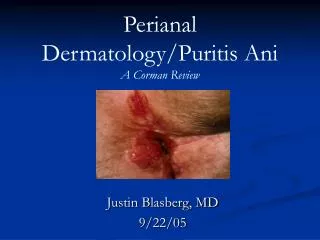
Perianal Dermatology/Puritis Ani A Corman Review
560 likes | 5.72k Views
Perianal Dermatology/Puritis Ani A Corman Review. Justin Blasberg, MD 9/22/05. What to look forward to?. Description of skin conditions affecting the perianal area Review of the differential diagnosis Examples of common and uncommon findings Treatment of the relevant diseases.


Perianal Dermatology/Puritis Ani A Corman Review
E N D
Presentation Transcript
Perianal Dermatology/Puritis AniA Corman Review Justin Blasberg, MD 9/22/05
What to look forward to? • Description of skin conditions affecting the perianal area • Review of the differential diagnosis • Examples of common and uncommon findings • Treatment of the relevant diseases
Classification of Skin Conditions • Inflammatory • Infectious • Neoplastic
Inflammatory • Pruritus ani • Psoriasis • Lichen planus • Lichen sclerosus et atrophicus • Atrophoderma • Contact (allergic) dermatitis • Seborrheic dermatitis • Radiodermatitis • Behcet’s syndrome • Lupus erythematosus • Dermatomyositis • Scleroderma • Erythema multiforme • Familial benign chronic pemphigus (i.e. Hailey-Hailey) • Pemphigus vulgaris • Cicatricial pemphigoid
Infectious Nonvenereal: • Pilonidal sinus • Suppurative hidradenitis • Anorectal abscess and anal fistula • Crohn’s disease • TB • Actinomycosis • Fournier’s gangrene • Ecthyma gangrenosum • Herpes Zoster • Vaccinia • Tinea cruris • Candidiasis • “Deep” Mycoses • Ambebiasis cutis • Trichomoniasis • Schistosomiasis cutis • Bilharziasis • Oxyuriasis (i.e. pinworm, enterobiasis) • Creeping eruption (i.e. larva migrans) • Larva currens • Cimicosis (i.e. bedbug bites) • Pediculosis • Scabies
Infectious Venereal: • Gonorrhea • Syphilis • Chancroid • Granuloma inguinale • Lymphogranuloma venereum (Chlamydia infection) • Molluscum contagiosum • Herpes genitalis • Condylomata acuminate
Neoplastic • Acanthosis nigricans • Leukoplakia • Mycosis fungoides • Leukemia cutis • Basal cell carcinoma • Squamous cell carcinoma • Malignant melanoma • Bowen’s disease • Extramammary Paget’s disease
Pruritus Ani • “itching in the anal area” • Symptoms: • Itching of anal and genital areas • Worsening at night • May awaken the patient from sleep • Scratching with exacerbation of complaint • Chronic itching can lead to atrophic or hypertrophic skin, with associated nodularity and scarring
Pruritus Ani Differential • Hemorrhoids • Anal fissure • Scarring from prior anal surgery • Constipation/diarrhea • Contact dermatitis • Mycoses • Seborrhea • Diabetes • Pinworm • Psoriasis • Neurodermatitis
Why me, why now? • Increased anal sphincter relaxation in response to rectal distension • Abnormal rectoanal inhibitory reflexes and a lower threshold for internal sphincter relaxation
Evaluation • Anoscopy and proctosigmoidoscopy • Magnifying lens • Woods lamp • Skin scrapings • Stool assessment?
What you might see • Marked edema with papillomatosis and nodularing resulting from chronic abrasion
Treatment • Injections of local anesthetics, phenol, and alcohol • Methylene blue • Diet modification • Sterilization? • Antibiotics?
Psoriasis • Chronic inflammatory disease of the skin • Characterized by rounded circumscribed erythematous dry scaling patches covered by grayish white or silvery white scales • Predilection for scalp, nails, extensor surfaces or limbs, elbows, knees, and sacral regions • Butterfly distribution over the coccyx and sacrum
Treatment • Moisturizers and agents with salicylic acid • Topical corticosteroids • Coal tar • Anthralin • Retinoid • Vitamin D3 derivatives • Ultraviolet B light • PUVA treatment • Methotrexate and Cyclosporine
Lichen Planus • Eruption of small, flat-topped papules with a distinct violaceous color and polypoid configuration • Found in flexor surfaces, mucous membranes, genitalia, and perianal area • Focal thickening of the granular layer, degeneration of the basement membrane and basal cells, and a bandlike lymphocytic infiltrate in the upper dermis • Diagnosis made with skin biopsy • Treatment with corticosteroids and occlusive dressings
What you might see • Moderate hyperkeratosis, thickening of the stratum granulosum, saw tooth configuration of rete ridges, and lymphocytic infiltration
Irritant and Contact Dermatitis • Irritant: Nonallergic reaction following exposure to an irritating substance • Alkalis, acids, metal salts, dusts, gases, and hydrocarbons • Allergic (contact): Allergic sensitivity to a number of responsible agents, also known as hypersensitivity of the delayed type (cell mediated hypersensitivity) • Dyes, oils, resins, chemicals used on fabrics, cosmetics, insecticides
Radiodermatitis • Secondary to radiotherapy of the rectum, anus, and prostate • Cell mitosis is arrested; skin change results from the dosage of radiotherapy • Erythema, edema, ulceration, and symptoms of burning, itching, or severe pain • Treatment with oral Vitamin A 8000IU BID • Hyperbaric O2 has also been found to be helpful
What you might see • Fibrosis of the dermis with sclerosis, atrophy of the epidermis, and absence of skin appendages
Pilonidal Sinus • Common infective process occurring in the natal cleft and sacrococcygeal region • Affects young adults and teenagers • 3:1 male predominance • Epithelium lined sinus is usually found to contain hair • Sinus may become infected, usually after puberty, with drains openings overlying the coccyx and sacrum • Infected abscess may extend to the perianal area that may be mistaken for an anal fistula
Why me, why now? • 2 Theories of formation: • Failure of fusion in the embryo, with entrapment of hair follicles in the sacrococcygeal region • Result of trauma, with the introduction of hair shafts into the subdermal area
Symptoms • Pain, swelling, purulent drainage at and around the site of the pilonidal opening • Typical appearance of an abscess may be evident • Fever and leukocytosis may be present
What you might see • Multiple openings overlying the sacrum and buttocks
What you might see • Indolent, granulating, nonhealing wound of a recurrent (persistent) pilonidal sinus
Treatment • Antibiotics? • Adjuvant to a surgical procedure • I&D • Definitive therapy: • Excision, excision with grafting or with an open wound to close secondarily, cryosurgery, and injection of sclerosing agents
Tuberculosis • Confused for Crohn’s, actinomycosis, anal fistula, colloid carcinoma, sarcoidosis, other skin conditions • Anal fistula is the most frequent presentation • Lesion appears as brownish red papule that can progress to an ulcerating plaque • Anal fissure in an unusual location that is slow to heal should raise the suspicion • Treatment: anti-TB drugs with resolve usually in 2 to 3 weeks
STD’s • Gonorrhea • Chancroid • Chlamydia • Herpes Simplex • Syphilis: • Chancre • Condylomata lata
What you might see • Large perianal mucoid warty mass composed of smooth-surfaced lobules
Neoplastic • Premalignant Lesions • Acanthosis Nigricans-ominous association with abdominal cancer • Affects face, neck, axillae, external genitalia, groin, inner thighs, umbilicus, and anus • Grayish velvety thickening or roughening of the skin • Epidermal papillomatosis, hyperkeratosis, and hyperpigmentation • Treatment is directed to the primary malignant condition
Premalignant Lesions • Leukoplakia • Whitish thickening of the mucous membrane epithelium occurring in patches of diverse size and shape • Seen in the anal canal • Associated with an increased risk of malignancy/epidermoid carcinoma • Symptoms of bleeding, discharge, and pruritic symptoms are the most common complaints • Hyperkeratosis and squamous metaplasia
Skin Cancer • Basal Cell Carcinoma • Most common cutaneous malignancy, extremely rare in the anal area • Tumors usually between 1-2 cm • Presents with a lump or ulcer • Bleeding, pain, pruritis, and discharge may be present • Treat with local excision and adequate margins • APR resection is performed for extensive or infiltrating tumors
What you might see • Ulcerating tumor has a pearly border
Skin Cancer • Squamous Cell/Epidermoid carcinoma • Tumor appears superficial, discrete, and hard • Ulcerates with progression • Mets to regional lymph nodes can occur • Treat with wide local excision
What you might see • Ulcerating friable tumor is noted
Bowen’s disease • Intraepidermal squamous cell carcinoma that spreads intraepidermally • Precursor to squamous cell carcinoma of the anus • Associated with HPV infection • Itching and burning, pain and bleeding • Treatment wide local excision with frozen section to ensure adequate margins
What you might see • An indurated erythemato-squamous patch involving the perianal area
Extramammary Paget’s Disease • Large, round, clear-staining cells with large nuclei • Symptoms of ulceration, discharge, pruritis, and occasionally bleeding and pain • Treatment depends on the presence/absence or underlying invasive carcinoma • Use of retinoid, etretinate, may benefit when there is no invasive carcinoma • More infiltrating disease an APR may be needed, otherwise wide local excision with grafting should be adequate for noninvasive disease
What you might see • Irregular but well-marginated erythematous erosive patch with slightly indurated edges
Extramammary Paget’s Disease • Stage I-localized perianal disease without carcinoma-tx with wide local excision • Stage IIA-localized disease without underlying malignancy-tx with wide local excision • Stage IIB-localized dx with associated anorectal carcinoma-tx with APR • Stage III-associated carcinomatous spread to regional lymph nodes-tx with APR plus chemoradiation, possible radical inguinal node dissection • Stage IV-distant mets-tx with standard palliative cancer management