7.3 Binomial Trials
This text explores binomial trials, which are experiments with two outcomes labeled as success or failure. Key concepts include the definition of binomial trials and their probability implications, where p represents the probability of success and q (1-p) represents the probability of failure. Examples such as coin tosses, drug effect classifications, and light bulb manufacturing are discussed. We also examine specific scenarios, like calculating the probability of a baseball player achieving a certain number of hits in a game using binomial probability formulas.


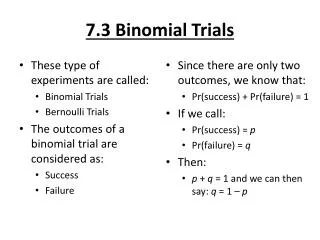
7.3 Binomial Trials
E N D
Presentation Transcript
7.3 Binomial Trials • Binomial Trials: Success/Failure • Probability of k Successes
Binomial Trials: Success/Failure An experiment with just 2 outcomes is called a binomial trial (or Bernoulli trial.) One outcome is labeled a success and the other is labeled a failure. If p is the probability of success, the q = 1 - p is the probability of failure.
Example Binomial Trials • Examples of binomial trials: • 1. Toss a coin and observe the outcome, heads or tails. • 2. Administer a drug to a sick individual and classify the reaction as "effective" or "ineffective." • 3. Manufacture a light bulb and classify it as "nondefective" or "defective."
Probability of k Successes If X is the number of "successes" in n independent trials, where in each trial the probability of a "success" is p, then for k = 0, 1, 2,…, n and q = 1 - p.
Example Probability of k Successes Each time at bat the probability that a baseball player gets a hit is .300. He comes up to bat four times in a game. Assume that his times at bat are independent trials. Find the probability that he gets (a) exactly 2 hits and (b) at least 2 hits.
Example Probability of k Successes (a) Each at-bat is considered an independent binomial trial. A "success" is a hit. So p = .300, q = .700 and n = 4. X is the number of hits in four at-bats. (a)
Example Probability of k Successes (b) "At least two hits" means X> 2.
Summary Section 7.3 • If the probability of success in each trial of a binomial experiment is p, then the probability of k successes in n trials is where q = 1 – p.