Understanding Catalyzed Rate Constants in Chemical Reactions
40 likes | 137 Views
Learn about catalyzed activation energy and rate constants in chemical reactions, as well as catalyst types and reactions involving homogenous catalysts.


Understanding Catalyzed Rate Constants in Chemical Reactions
E N D
Presentation Transcript
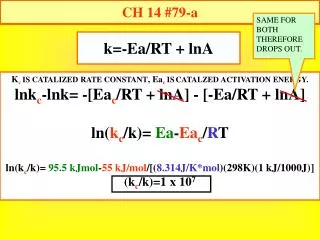
CH 14 #79-a SAME FOR BOTH THEREFORE DROPS OUT. k=-Ea/RT + lnA Kc IS CATALIZED RATE CONSTANT, Eac ISCATALZED ACTIVATION ENERGY. lnkc-lnk= -[Eac/RT + lnA] - [-Ea/RT + lnA] ln(kc/k)= Ea-Eac/RT ln(kc/k)= 95.5 kJmol-55 kJ/mol/[(8.314J/K*mol)(298K)(1 kJ/1000J)] (kc/k)=1 x 107
CH 14 #79-a A IS SAME FOR BOTH THEREFORE DROPS OUT. k=-Ea/RT + lnA Kc IS CATALIZED RATE CONSTANT, Eac ISCATALZED ACTIVATION ENERGY. lnkc-lnk= -[Eac/RT + lnA] - [-Eac/RT + lnA] ln(kc/k)= Ea-Eac/RT ln(kc/k)= 95.5 kJmol-55 kJ/mol/[(8.314J/K*mol)(398K)(1 kJ/1000J)] (kc/k)=2 x 105
CH 14 #71- 2[NO2(g) + SO2 (g) NO(g) + SO3 (g)] 2 NO(g) + O2 (g) 2 NO2 (g) 2SO2 (g) + O2 (g) 2 SO3 (g) WHERE NO2 IS A CATALYST, IT IS IN THE GAS STATE AS ALL OTHER SPECIES, THEREFORE IT IS A HOMOGENOUS CATALYST.
CH 14 #65 Rate = k[H2][ICl] SLOW H2(g) + ICl (g) HI (g) + HCl (g) HI(g) + ICl(g) I2 (g) + HCl (g) H2(g) + 2 ICl(g) I2 (g) + 2HCl (g) RATE = k[H2][HCl] Rate = k[HI][HCl]