Roadway Design Models: Streamlining Conversion for Driving Simulation
This presentation discusses the critical process of converting transportation models into driving simulator models, highlighting the importance of visualization, stakeholder buy-in, and proof of concept. It covers the operational aspects of driving simulation, including virtual testing and the role of driving simulators in research, training, and outreach. Case studies such as the MnDOT Highway 61 Bridge Project and the Diverging Diamond Interchange illustrate the application of simulation in real-world scenarios. The challenges faced in data processing and future steps to enhance model fidelity are also addressed.

Roadway Design Models: Streamlining Conversion for Driving Simulation
E N D
Presentation Transcript
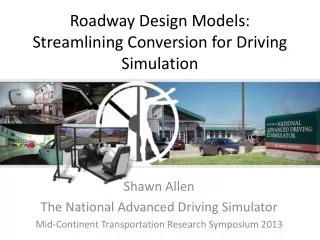
Roadway Design Models:Streamlining Conversion for Driving Simulation Shawn Allen The National Advanced Driving Simulator Mid-Continent Transportation Research Symposium 2013
Background • Visualization • Look and feel of project • Design proof of concept • Buy-in from project stakeholders • Limited presentation of operational aspects • Driving Simulation • Virtual “computerized” model • Test drive of appearance AND operation • As with visualization, comes in many “flavors”.. Ie, levels of simulator fidelity
Test Drive It Before You Build It • Virtual proof of concept • Build it in a computer before you actually build it in the real world • Determination of satisfactory conditions • Public relations
Visualization Case Studies MnDOT Highway 61 Bridge Project
Is a Driving Simulator aGood Test Case? http://www.madsciencemuseum.com/msm/pl/billboard_experiment
Making A Case for Driving Simulators • FAA guidelines permit pilot training on certified simulators to substitute for actual hands-on in the real-world • Extensive simulation use across industry sectors http://newshopper.sulekha.com/boeing-787-flight-simulator_photo_1481525.htm http://www.graphit.hu/Tecnomatix/Products/Plant%20Simulation.aspx
Uses of Driving Simulation for Transportation Visualization • Research • Training • Outreach • Human factors and operational evaluation: • Speed selection • Lane selection • Gap acceptance • Sign comprehension and compliance • Workzone driving performance
FHWA Simulator Case Study • Diverging Diamond Interchange http://www.fhwa.dot.gov/publications/research/safety/07048/
Transportation Model Conversion to Driving Simulator Model Transportation model Driving simulator model
Transportation Design Model • Goal: “hands-free” conversion • Significantly more data than needed for simulation • Access to required elements requires adherence to design standards or robust interrogation algorithms, or both
Elements Required* for Simulation *Characteristics for NADS simulators
Design Model Data Processing Iowa DOT/InTrans Converter Prototype Technical Report
Issues Encountered • Challenges accessing source data • Invalid data in test model (source) Boundary data spikes Triangulated surface errors at overpass
Future Steps • Identify & secure project funding • Proposal under review for University of Iowa to become a University Transportation Center • Improve surface processing to include texture • Improve data algorithms for general-purpose • More model design types • Greater project complexity • Smooth junction connectors • Include additional attributes • Lane markings, signage, etc.
Thank You! Virtual Iowa City Simulator Model contacts@nads-sc.uiowa.edu
Acknowledgements • The Iowa Department of Transportation • Center for Transportation Research and Education at Iowa State University • Charles Hixon III, Bergman Associates • Michael Manore, Vispective Management Consulting