Download
1 / 15
150 likes | 271 Views
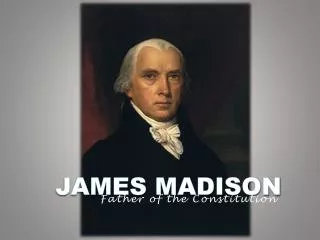
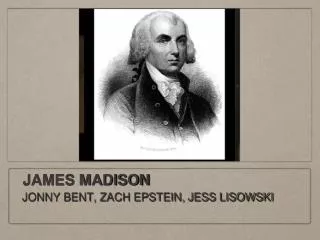
Born on March 16, 1751, James Madison was an influential Virginia planter and legal scholar who played a crucial role in American history. He was instrumental in drafting the U.S. Constitution and led the nation as its fourth president during pivotal times, including the War of 1812. Madison's leadership helped navigate tensions with Britain, manage domestic affairs, and ultimately secure American independence from European control. His presidency marked significant challenges and victories, shaping the young nation.

E N D
JAMES MADISON • JONNY BENT, ZACH EPSTEIN, JESS LISOWSKI
BACKGROUND INFORMATION • Born March 16th, 1751 • Lived on a Plantation in Virginia • Studied Law but did not like it • In 1774, he took a seat on a local safety committee, a pro-revolution group that oversaw the militia
BACKGROUND INFORMATION • Madison expanded into other political offices throughout his life before his presidency • Took interest to politics during revolutionary years • Madison wrote the majority of the Constitution
James Madison’s Home James Madison’s First Lady, Dolley Madison
PRESIDENTIAL ELECTIONS ELECTION OF 1808 • Republican Party • Defeated Charles Cotesworth Pickney • Federalists were against the Embargo- prohibited American ships from leaving the US to go to foreign ports • Created Limited Embargo on Britain and led to war of 1812
PRESIDENTIAL ELECTIONS ELECTION OF 1812 • Republican • Defeated DeWitt Clinton • The war of 1812 got Madison re-elected because the country was going into war and it would be detrimental to switch office • Madison served his second term to fight and win the war of 1812
MAJOR ISSUES 1st Term • 1. GB + France hinder US trade and ships. - GB Impressment US Crews (GB ports in the US) - GB sinks “Chesapeake” Republicans want war • - Non Intercourse Act expires replaced with Macon’s 2nd Bill commercial relations w/ GB + France but President has authority to prohibit trade • 2. Tecumseh + Prophet unite Tribes + resist US expansion - GB in Canada helps Indians • - Will Henry Harrison attacks Prophetstown destroys influence of 2 Indian leaders
MAJOR ISSUES 1st TERM 3. Slaves escaping into Florida - Indians in Florida attack white settlers - white settlers want Florida ports (trade in the gulf) - US settlers in Florida seize Baton Rouge + Madison annexes territory plans to take Florida. - Ppl want war w/ GB b/c they were allies w/ Spain + gave Natives weapons gives an excuse to take Florida
EFFECTIVENESS 1st TERM • France announces it will not interfere with US shipping - GB economy hurt by embargo repeals blockade of Europe but too late to prevent war • 2. Tecumseh + Indian troops raid white settlement from Michigan to Mississippi in 1812 • 3. June 18th, 1812: US declares war on GB - War Hawks (Western Congressmen) want war - country is split into parties.
MAJOR ISSUES 2nd TERM • 1. Battles with Tribes in war of 1812: • -Canada: US Losing early battles vs GB • - US continues to attack Canada and Great Lakes • 2. Creeks Indians in Florida attacking Border States • - Andrew Jackson fights back and slaughters women, children, and Native Amer warriors in Battle of Horseshoe Bend • 3. GB burns Washington DC + advances to Baltimore US stops them at battle of Plattsburgh • - US Army guards Baltimore and sinks ships in the harbor to block Brit ships
MAJOR ISSUES 2nd TERM • 4. GB attacks New Orleans • - Andrew Jackson organizes troops to counter sets up fortification to protect troops • 5. Feds in NE don’t like war and want to separate from the union. • - Feds meet at Hartford convention to discuss grievances and demand amendments to the Constitution • 6. Agreeing on treaty with Great Britain - GB no longer at war with Napoleon. The negotiations had been going on since the beginning of the war • - Treaty of Ghent finally singed December 25th, 1814
EFFECTIVENESS 2nd TERM 1. Harrison wins battle at Thames River kills Tecumseh which greatly weakened Native American forces - US successfully destroys last of Indian resistance in North 2. Breaks Creeks resistance + they give up land to US - Andrew Jackson becomes major general in the US Army; on November 7th, 1814 he moves into Florida and seizes the Spanish port Pensacola - US effectively invades Florida + eventually makes Florida a territory 3. US repels the British attack on Baltimore and the battle of Plattsburgh + successfully secures the North Border of the US
EFFECTIVENESS 2nd TERM 4. British troops at NO unprotected; got crushed wave after wave GB have 700 dead, 1,100 wounded and 500 are prisoners US lost 8 w/13 wounded - Battle of NO occurred after Treaty of Ghent was signed b/c news took time to get to North America - effectively finalizes the fighting and ends war w/ triumphant US victory 5. Soon after NE made demands to Congress, news of the treaty and Andrew Jackson’s victory reached North Hartford convention and Fed party’s issues become irrelevant - Fed party influence finally destroyed by Republican and Madison 6. GB keeps Canada and continues impressment - GB gives up a call for an Indian buffer territory and more treaties follow like the Rush Bagot treaty - disarmament on Great lakes(border peace between US and Canada. 1818 treaty- US has free trade with Britain and the Indians were supposed to get land back and but did not, so whites continued to expand west.
QUOTE "KNOWLEDGE WILL FOREVER GOVERN IGNORANCE; AND A PEOPLE WHO MEAN TO BE THEIR OWN GOVERNORS MUST ARM THEMSELVES WITH THE POWER WHICH KNOWLEDGE GIVES"(MADISON).
BIBLIOGRAPHY • BrainyQuote. Xplore, n.d. Web. 01 Dec. 2013. <http:// www.brainyquote.com/quotes/authors/j/ james_madison.html>. • "James Madison." Wikipedia. Wikimedia Foundation, 29 Nov. 2013. Web. 30 Nov. 2013. <http://en.wikipedia.org/ wiki/James_Madison>. • "Miller Center." American President: James Madison: Life Before the Presidency. N.p., n.d. Web. 01 Dec. 2013. <http://millercenter.org/president/madison/essays/ biography/2>.