Download
1 / 35
350 likes | 472 Views
Mono Lake, an ancient saline lake, is known for its striking tufa formations that emerge from calcium-rich springs mixing with alkaline waters. Once deeper, the lake's ecosystem supports diverse wildlife, including migratory and nesting birds, as well as algae and brine shrimp that thrive in its unique conditions. Since the diversion of water began in 1941, salinity levels surged, significantly altering the ecosystem. The lake has experienced cycles of meromixis, impacting its water turnover and oxygen levels, revealing the delicate balance of this high desert environment.

E N D
Mono Basin Water Flows http://www.monolake.org/
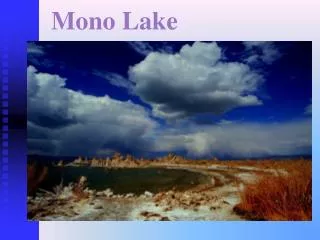
Mono Lake Tufas formed when calcium-bearing freshwater springs well up through the carbonate rich alkaline lake water. They show that the lake was much deeper in the past.
Ecosystem • Saline lake • Algae, Brine shrimp, Brine flies • High desert wildlife • http://www.latimes.com/news/local/la-me-mono24-2008jul24,0,5819920.story
Ecosystem • Migratory birds • Nesting birds
Diversion begins in 1941 Diversion increase Negit Island Landbridge Forms
1981: • Volume cut in half • Salinity climbed to 100 g/L • (55 g/L was normal) • *Elevation 6372 ft (45 ft below avg) Negit Island Landbridge Forms
Other comments • Mono Lake became meromictic between 1994 and 2005. (A 11 year interval of meromixis). • It’s normal state is monomictic, where seasonal flucuations is surface density driven by temperature variations cause yearly overturning of deep water with oxygen rich surface waters.