Download
1 / 1
10 likes | 148 Views
Effects of a Stimulant on a Lumbriculus variegates. Kali Benjovsky and Connor Barleben.

E N D
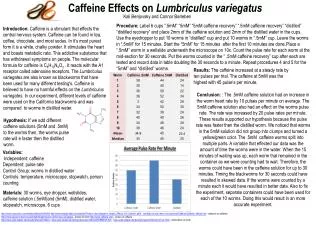
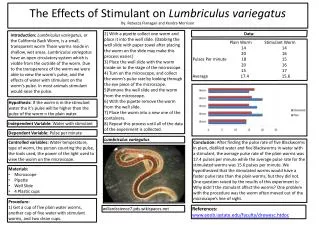
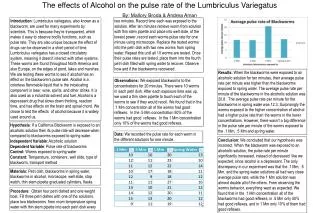
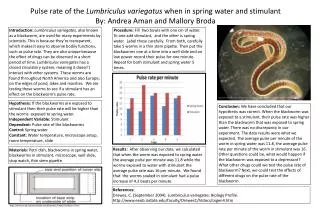
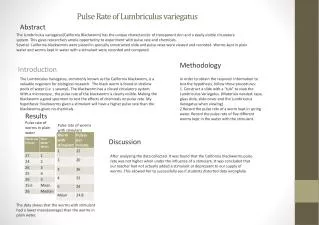
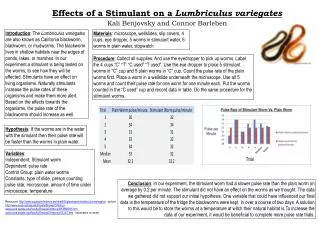
Effects of a Stimulant on a Lumbriculus variegates Kali Benjovsky and Connor Barleben Introduction: The Lumbriculus variegates are also known as California blackworm, blackworm, or mudworms. The blackworm lives in shallow habitats near the edges of ponds, lakes, or marshes. In our experiment a stimulant is being tested on the worms, to see how they will be effected. Stimulants have an effect on living organisms. Naturally stimulants increase the pulse rates of these organisms and make them more alert. Based on the effects towards the organisms, the pulse rate of the blackworms should increase as well. Materials: microscope, wellslides, slip covers, 4 cups, eye dropper, 5 worms in stimulant water, 5 worms in plain water, stopwatch Procedure: Collect all supplies. And use the eyedropper to pick up worms. Label the 4 cups “C” “T” “C used” “T used”. Use the eye dropper to place 5 stimulant worms in “C” cup and 5 plain worms in “C” cup. Count the pulse rate of the plain worms first. Place a worm in a wellslideunderneath the microscope. Use all 5 worms and count their pulse rate for one worm for one minute each. Put the worms counted in the “C used” cup and record data in table. Do the same procedure for the stimulant worms. Hypothesis: If the worms are in the water with the simulant then their pulse rate will be faster than the worms in plain water. Variables: Independent: Stimulant worm Dependent: pulse rate Control Group: plain water worms Constants: type of slide, person counting pulse rate, microscope, amount of time under microscope, temperature Conclusion: In our experiment, the stimulant worm had a slower pulse rate than the plain worm on average by 0.2 per minute. The stimulant did not have an effect on the worms as we thought. The data we gathered did not support our initial hypothesis. One variable that could have influenced our final data is the temperature of the fridge the blackworms were kept in over a course of two days. A solution to this would be to store the worms at a temperature at witch their natural habitat is.Toincrease the data of our experiment, it would be beneficial to complete more pulse rate trials. Resources: http://www.aquarium-kosmos.de/inhalt/42/glanzwurm-lumbriculus-variegatus - picture http://www.eeob.iastate.edu/faculty/DrewesC/htdocs www.eeob.iastate.edu/faculty/DrewesC/htdocs/WORMSO5.htm www.eeob.iastate.edu/faculty/DrewesC/htdocs/LVCULT.htm - Information on worm