Download

1 / 23
230 likes | 359 Views
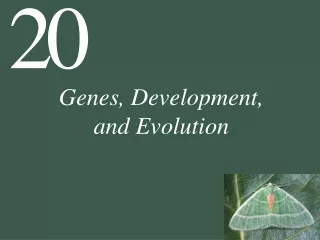
This chapter explores the intricate relationship between conserved genes, like Hox genes, and diverse morphological forms in organisms. It discusses how developmental changes, including heterochrony and homeosis, can trigger evolutionary change. The role of transcription factors and signaling pathways is examined, alongside examples like the Brassica plants and sticklebacks, demonstrating how mutations and gene duplication contribute to new forms and functions. The fascinating case of morning glories and eye pigmentation diversity highlights the complexity of evolutionary adaptation through genetic changes.

E N D