Place Value
This lesson explores the importance of numbers, their place values, and how to represent them in standard and expanded forms. Learn about comparing numbers with symbols, identifying face value versus place value, and practicing with various examples. By understanding place value charts, you will master writing numbers in different forms, enhancing your numeracy skills. Engage in practice exercises to reinforce your learning and complete your workbook for review. This comprehensive guide is essential for mastering basic operations involving numbers.


Place Value
E N D
Presentation Transcript
Place Value Lesson #1
Numbers are Important! • The name or symbol used to represent a number (#) is calleda • Why do we need numbers? NUMERAL
Review: Ways of Comparing Numbers • You can list them in increasing or decreasing order • Plan them on a number line • Or use the > (greater than) or < (less than) symbols
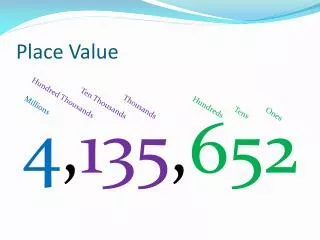
Place Value: • Each digit has a certain place value • Each place has a value of 10 times the place directly to its right
Face Value vs. Place Value • Face Value tells you how many ones, tens, or hundredths there are. Face value is the actual value of the digit. In the number 475, the "7" has a face value of 7. • Place value is what the digit represents IN ITS PLACE. In the number 475, the "7" is in the tens place, so the place value is 70
Standard Form • The full number • The way you “normally” write a number
Expanded Form • Writing a number showing the total place value of each digit • Example: 543 Placing the # into the Place Value Chart: From the chart we see 100 x 5 = 500 10 x 4 = 40 1 x 3 = 3 So 543 in expanded form 5 x 100 + 4 x 10 + 3 x 1
Expanded Form with Decimals Example: 48.25 Placing the # into the Place Value Chart: From the chart we see 40x 10 = 40 8 x 1 = 8 2 x 0.1 = 0.2 5 x 0.01 = 0.05 So 48.25in expanded form 4 x 10 + 8 x 1 + 2 x 0.1+ 5 x 0.01
Expanded Form: Practice • Complete the expanded form of the following numbers: 1) 384 = _______ + 8 x 10 + _______ 2) 6257 = 6 x 1000 + ______ + ______ + ______ 3) 37 = 10 x 3 + ________ 4) 4826 = ________ + 100 x 8 + _______ + _____ 5) 219.2 = ______ + _______ + ______ + ______ 3 x100 + 8 x 10 + 4 x 1 6x1000 + 2x100 + 5x10 + 7x1 3 x 10 + 7 x1 4x1000 + 8x100 + 2x10 + 6x1 2x100 + 1x10 +9x1 + 2 x 0.1
Standard & Expanded Form: Practice • What is the standard form of these expanded form numbers: 1) 800 + 40 + 3 = 2) 20 000 + 600 + 40 + 9 = 3) 1000 x 4 + 100 x 5 + 1 x 3 = 4) 100 x 9 + 1 x 8 + 0.1 x 5 = 843 20 649 4 503 908.5
For your notecard: PLACE VALUE & FORMS Thousands Hundreds Tens Ones/Units DECIMAL POINT Tenths Hundredths Thousandths Standard form is how a number is normally written (543) Expanded form shows each place value 543 = 5 x 100 + 4 x 10 + 3 x 1 48.25 = 4 x 10 + 8 x 1 + 2 x 0.1 + 5 x 0.01 < less than > greater than
Homework! • Complete the following questions in your workbook (this is a review of basic operations involving numbers) p. 1, #1-3 p. 2 #4, 5, 8 p. 3 #9 + 10 p. 4 #11 (try the challenge question #13) p. 5 #1-2 p. 6 #3-4