Analyzing Cancer Death Rates and the Evolution of Small Schools in U.S. Education (1980-2005)
80 likes | 177 Views
This report examines age-standardized death rates for kidney and ureter cancer among U.S. white males from 1980 to 1989, highlighting counties with both the highest and lowest rates. In a broader context, it explores the Bill and Melinda Gates Foundation's significant investment in small schools in the late 1990s, aimed at improving education. It discusses the effectiveness of small schools on student achievement, particularly evidenced by PSSA scores, and notes a shift in focus from small school initiatives to district-wide improvement strategies by 2005.


Analyzing Cancer Death Rates and the Evolution of Small Schools in U.S. Education (1980-2005)
E N D
Presentation Transcript
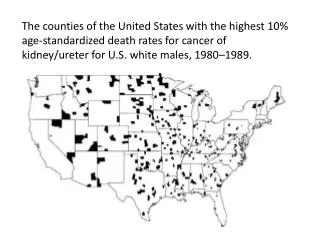
The counties of the United States with the highest 10% age-standardized death rates for cancer of kidney/ureter for U.S. white males, 1980–1989.
The counties of the United States with the lowest10% age-standardized death rates for cancer of kidney/ureter for U.S. white males, 1980–1989.
School Size In the late 1990’s the Bill and Melinda Gates Foundation began supporting small schools on a broad-ranging, intensive, national basis. By 2001, the Foundation had given grants to education projects totaling approximately $1.7 billion.
Small Schools • They were later joined in support for splinterring larger schools into smaller schools by the Annenberg Foundation, the Carnegie Corporation, the Center for Collaborative Education, the Center for School Change, Harvard’s Change Leadership Group, Open Society Institute, Pew Charitable Trusts, and the U.S. Department of Education’s Smaller Learning Communities Program. • What is the evidence in support of such a change?
PSSA • Consider the relationship between small schools and achievement in terms of the PSSA. • Examining the mean scores of the 1662 separate schools that provide fifth grade reading scores, we find that of the top scoring fifty schools (the top 3%), six of them were among the smallest 3% of the schools. • Of the fifty lowest scoring schools, nine (18%) were among the fifty smallest schools.
The End of the Small Schools Movement • On October 26, 2005, Lynn Thompson, in an article in the Seattle Times reported that “The Gates Foundation announced last week it is moving away from its emphasis on converting large high schools into smaller ones and instead giving grants to specially selected school districts with a track record of academic improvement and effective leadership. Education leaders at the Foundation said they concluded that improving classroom instruction and mobilizing the resources of an entire district were more important first steps to improving high schools than breaking down the size.”