Sponsor Preview Final Presentation
This presentation outlines a project aimed at designing a new basket for cold drawn tube manufacturing that significantly reduces solvent loss during the degreasing process. Utilizing insights from team members and comprehensive testing, the proposed solution features an innovative design with improved insulation, resulting in substantial solvent savings. The financial analysis indicates that after a brief period, the new baskets will pay for themselves through cost savings, paving the way for increased production. The plan emphasizes prototyping, testing, and strategic implementation in the manufacturing facility.

Sponsor Preview Final Presentation
E N D
Presentation Transcript
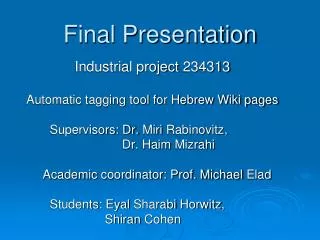
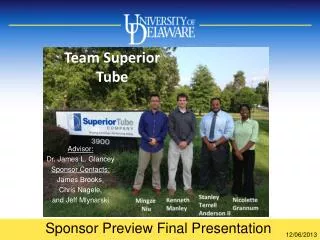
Team Superior Tube Sponsor Preview Final Presentation Advisor: Dr. James L. Glancey Sponsor Contacts: James Brooks, Chris Nagele, and Jeff Mlynarski 12/06/2013
Agenda • Introduction……………………………………………Stanley Anderson • Scope………………………………………………………….MingzeNiu • Wants, Needs, and Metrics…..…………………………..…MingzeNiu • Proposed Solution……………………………………...Kenneth Manley • Prototyping………………………………………...…Nicolette Grannum • Financial Overview…………………………………...Stanley Anderson • Path Forward……………………………………...…….Kenneth Manley
Introduction • Company produces cold drawn tubes • Tubes must be cleaned to sell to clients • Long tubes are loaded into a basket and into the solvent
The Problem • Solvent is n-Propyl Bromide or nPB • Aggressive solvent and hazardous at boiling • A refrigerated boundary layer keeps solvent vapors contained • Heated basket breaks the barrier causing solvent loss
Project Scope • The team is to design a basket that will reduce solvent loss throughout the degreasing process when compared to the current basket design. • The team is to have significant testing and/or a model to prove that the design will work as proposed.
Proposed Solution • Metric measurements • Weight: 454 lbs • Factor of Safety: 10 • Points of Contact: 6 • Material Cost: ~ $18,500 • < • 10% additional loading area (800 sq. in.)
Prototype Testing and Goals • Outcomes • Confirm material selection • Determine practicality of insulation • Limitations • Test with temperature only, not actual solvent • Structural components and shape will not be tested
Material Testing • Finite Element Analysis (FEA) validated structure, but cold barrier information is limited • Scale test using hot plate, water, and metal samples to show effectiveness of both material change and insulation • These samples were cross referenced and a general assumption that less heat released in the cold barrier would lead to decreased nPB loss Shown above: Titanium sample covered with a sample of Aerogel insulation and sealed with a rubber coating
Material Test Results • The insulation reduced heat transfer by over eighty percent • Based on the design, energy deposited in the boundary layer is reduced • Reduction in nPB losses, creating a huge opportunity for savings
Fabrication Process • Basket material available from titanium supplier • Transportation to and from the machinist is offered by supplier • From there the welding contact can fabricate the basket
Financial Overview - Background • Overview of estimated solvent savings • Scenarios generated with the following assumptions • Two barrier breaks per dip • Losses per dip were the same • Low cost of capital • Fiver percent production growth rate
Financial Overview – Analysis • Short term prospects for single baskets are dismal • Effect of the increased product load removes run time losses • After two years, the baskets will more than pay for themselves • If pursued, two baskets will be the best prospect
Financial Overview – Continued • From here, the need for two baskets is apparent • The total savings counters the increased emissions • The scenario facilitates increased production
Path Forward • Determine loading conditions of side and end meshes • Recommendation of the basket fabrication strategy • Develop more comprehensive financial strategy • Pursue design and implement the basket in facility