Download
1 / 12
120 likes | 236 Views
This presentation highlights the necessity of collaboration among physicians and staff to improve clinical outcomes and patient care. We focus on the value of monitoring resource utilization and implementing timely transitions to ensure patients receive the right level of care at the right time. The Affordable Care Act's mandate for a readmission reduction program is discussed, showcasing alarming statistics like the 20% readmission rate of Medicare patients. We explore the fragmentation in post-acute care and advocate for coordinated care partnerships to enhance patient satisfaction and outcomes.

E N D
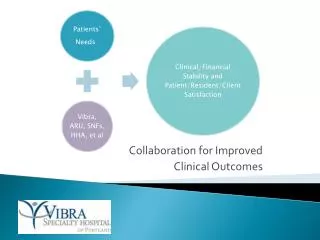
Collaboration for Improved Clinical Outcomes
Goals • Physicians and staff working as partner for patient care • Value of monitoring utilization of resources • Timely transitions: “Right level of care at the right time”
Readmission Focus • The Affordable Care Act of 2010 requires HHS to establish a readmission reduction program. • 20% of Medicare patients are readmitted to a hospital within one month of discharge • CMS’ goal to transition to value based purchasing--paying for care based on quality and not just quantity • Initial focus- AMI, CHF and pneumonia; 2015 possibilities- MedPAC recommendations of COPD, CABG and PTCA procedures, and other vascular procedures • Penalties- Oct 2012- 1%; Oct 2013- 2%; Oct 2014- 3%
Breakdown of Inpatient Readmission Source Source: Health Care Financing Review| 2009 data
Current Industry Issues § Highly fragmented market of hospitals and PAC providers § Economic incentive for acute care providers to increase PAC patient volume and rapidly discharge § No coordination of patients over episode of care § No economic penalty for poor performance Medicare Policy is Rearranging the Post-Acute Landscape ____________________ Source: RTI International, 2009, “Examining Post Acute Care…” and Avalere Health, LLC, “Change in the SNF Marketplace” March 2012. Same Source for next slide
National Statistics 23% are Readmitted to Hospital 35% of Hospital Discharges are Admitted to Post- Acute for Additional Care (“Post-Acute Admissions”) 48% of Post-Acute Admissions go Home after Receiving Post-Acute Care 29% are Transferred to a Secondary Post-Acute Venue for Additional Care Medicare Statistics
30-day Risk Adjusted Readmission Rates for a Portland Hospital Source: America Hospital Directory, 07/01/2008 to 06/30/2011 posted on 04/12/2013
Continuum of Care • Long Term Acute Care- MS DRGs • Skilled Nursing facilities- RUGs and per diem • Foster Home- per diem; Medicare not accepted • Home Health- DRGs • Hospice- per diem
What is a DRG? • Present- MS DRGs • MCC • CC • Non-CC • Future • Length of Stay • Short Stay • Long Stay • Medicare median
Opportunities • Improved clinical outcomes and patient satisfaction through coordination of care. • Right level of care at the right time for optimal patient care outcomes. • Partnerships for coordination of care
Thank You! Coming together is a beginning. Keeping together is progress.Working together is success. - Henry Ford