Download
1 / 15
150 likes | 242 Views
Explore the groundbreaking Human Genome Project, initiated in 1988 with $3 billion funding from NIH and US Dept. of Energy. Discover how mapping human chromosomes and identifying genes impact genetic research and human health. The project sequenced 3 billion base pairs, analyzed genetic variation, and utilized model organisms like bacteria, yeast, plants, fruit flies, and mice. Learn how the project addressed ethical, legal, and social implications of genome research. Delve into the DNA sequencing process, genetic content, and insights gained from comparative genomics with yeast, Drosophila, and mice. Uncover the book that "wrote itself" through comparative genomics and how model organisms advance scientific understanding.

E N D
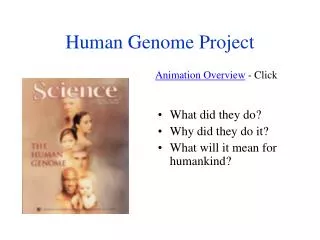
Human Genome Project Animation Overview - Click • What did they do? • Why did they do it? • What will it mean for humankind?
Brief history of the work… • Proposed in 1985 • 1988. Initiated and funded by NIH and US Dept. of Energy ($3 billion set aside) • 1990. Work begins. • Published in Science and Nature in February, 2001
Goals of HGP • Create map of the 22 human chromosomes, X / Y) • Identify the entire set of genes & map them all to their chromosomes • Determine the nucleotide sequences of the estimated 3 billion base pairs • Analyze genetic variation among humans
Model organisms • Bacteria (E. coli, influenza, several others) • Yeast (Saccharomyces cerevisiae) • Plant (Arabidopsis thaliana) • Fruit fly (Drosophila melanogaster) • Mouse (Mus musculus)
Goals of HGP (cont’d) • Develop new laboratory and computing technologies to make all this possible • Disseminate genome information • Consider ethical, legal, and social issues associated with this research
How they did it… • DNA from 5 humans • 2 males, 3 females • 2 caucasians, one each of asian, african, hispanic • Cut up DNA with restriction enzymes • Sequenced the fragments • Let a supercomputer put the pieces together
Human genome content • 1-2 % codes for protein products • 24% important for translation • 75% “junk” • Repetitive elements • Transposons • Retrotransposons BOOK THAT WROTE ITSELF
Yeast • 70 human genes are known to repair mutations in yeast • Nearly all we know about cell cycle and cancer comes from studies of yeast • Advantages: • fewer genes (6000) • few introns • 31% of yeast genes give same products as human homologues
Drosophila • nearly all we know of how mutations affect gene function come from Drosophila studies • We share 50% of their genes • 61% of genes mutated in 289 human diseases are found in fruit flies • 68% of genes associated with cancers are found in fruit flies
Mouse • known as “mini” humans • Very similar physiological systems • Share 90% of their genes