Download
1 / 17
170 likes | 302 Views
This educational material explores the fundamental concepts of matter, distinguishing between physical and chemical changes. It provides examples of pure substances, elements, and compounds, while highlighting the properties and behaviors of matter. The text delves into physical properties that can be observed without altering the substance and explains methods like distillation for separating mixtures. By contrasting physical and chemical changes, such as rusting and baking, students gain a comprehensive understanding of matter's composition and interactions.

E N D
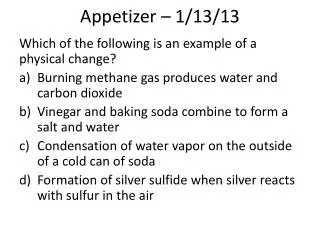
Appetizer – 1/13/13 Which of the following is an example of a physical change? • Burning methane gas produces water and carbon dioxide • Vinegar and baking soda combine to form a salt and water • Condensation of water vapor on the outside of a cold can of soda • Formation of silver sulfide when silver reacts with sulfur in the air
Chapter 15 The Classification of Matter
Section 1: The Composition of Matter Matter – What is it? • Has mass and takes up space • Is made of atoms • Is defined by what it’s made of and how it interacts with other types of matter
What is Matter? Matter Not Matter Heat Light sound • Living things • Non living things • Air • The earth
Pure Substances • Pure substances have a fixed composition meaning that any sample of the substance is always made of the same thing • Examples: Water, Salt, gold, graphite (pencil lead), oxygen
Elements • A pure substance that is made of atoms which are all identical • About 90 elements are found on earth • Examples: iron (Fe), helium (He), oxygen (O) , copper (Cu), gold (Au), aluminum (Al),
Compounds • Two or more atoms combine in fixed ratios to form compounds • Examples: water (H2O), carbon dioxide (CO2), salt (NaCl) + =
Mixtures • Two or more substances that can be separated with physical processes • Do not always contain the same types of ingredients in the same proportions • Example: pizza
Section 2: Properties of Matter Physical Properties – any characteristic of matter that you can observe without changing the identity of the substances that make up the material • Examples: color, shape, appearance, texture, size, melting point, boiling point, density
Physical Properties • Appearance and behavior • Examine the playdoh with a partner. Write down all of the physical properties of the playdoh that you can find
Physical Properties • Mixtures can be separated based on physical properties of the substances • Examples: pouring pasta and water into a strainer, separate iron filings from sand with a magnet, filtering water
Physical Change • Freezing- liquid solid : water ice • Boiling - liquid gas : water steam • Evaporation - liquid gas : water water vapor • Melting - solid liquid : ice water • Condensing - gas liquid : water vapor drops
Because all substances have distinct properties like densities, specific heats, melting, and boiling point, these properties can be used to help identify when a mixture contains a particular substance
Using physical change to separate • Distillation is a process where a mixture is separated by heating the mixture and condensing the liquid that evaporates. • Used to make drinking water out of sea water when fresh water is not available
Chemical Changes • New substances are produced when a chemical change occurs • Heat, cooling, formation of bubbles, and color change can all indicate a chemical change • Examples: rust on a car fender, baking cookies, mixing baking soda and vinegar
Review • This assignment must be completed for homework if you do not finish by the end of class! • Page 470 # 1-7 (fill in the blank. Just write the word) • Page 471 # 19 (use the concept map print-out)