Download
1 / 19
190 likes | 293 Views
Explore the basics of atoms, isotopes, atomic mass, and the Periodic Table, including elemental properties and mass spectroscopy. Learn about metals, non-metals, and metalloids.

E N D
Atoms Atoms are made of protons, neutrons, and electrons.
Atomic number • The atomic number (Z) of an element is the number of protons in the nucleus of an atom of that element. • Since atoms are electrically neutral, the number of electrons (-) must equal the number of protons (+).
Atomic symbol Periodic Table
Isotopes • Isotopes: same # protons, different # neutrons • Symbol:
Atomic mass • Atomic mass is a weighted average mass of the atoms in a naturally occurring sample of the element. • Calculate: multiply the atomic mass of an isotope by its percentage/100. • Do this for every isotope. • Add the atomic masses found.
Isotopes • Gallium is a metallic element found in small lasers used in compact disc players. In a sample of gallium, there is 60.2% of gallium-69 (68.9 amu) atoms and 39.8% of gallium-71 (70.9 amu) atoms. What is the atomic mass of gallium?
Ga-69 68.9 amu x 60.2 = 41.5 amu for 69Ga 100 Ga-71 70.9 amu x 39.8 = 28.2 amu for 71Ga 100 Atomic mass Ga = 69.7 amu
Abundance • Percent abundance: % of total • Relative abundance: Most abundant isotope set at 100 %, other relative to most abundant one.
Mass Spectroscopy Mass spectroscopy provides an accurate way of measuring the mass of atoms and molecules.
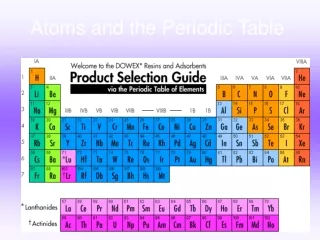
Periodic Table • horizontal rows: periods • vertical columns: groups or families • groups 1 and 2 (1A and 2A) and groups 13-18 (3A – 8A) are called representative elements • groups 3-12 are the transition metals • Lanthanides and Actinides
Periodic Table • Three main classes of elements: 1. metals 2. nonmetals 3. metalloids
Metals • Most elements are metals. Properties: • Good conductors of heat and electricity • Solid at room temperature (except Mercury) • Reflect light (shiny) • Lose electrons in reactions
Non-metals • Located in the upper right corner of PT • Greater variation among these than metals. • Most are gases at room temperature. • A few are solids (C, S, P) and one is a liquid (Br) • Tend to have properties opposite of metals. • Gain electrons in reactions.
Metalloids • Generally have properties similar to metals and nonmetals. • An element in this group may behave like a metal under certain conditions, and then behave like a nonmetal under different conditions. • For example, the metalloid Silicon is a poor conductor of electricity, but it becomes a good conductor when it is mixed with another metalloid, Boron.
Main groups • Group IA alkali metals • Group IIA alkaline earth metals • Group VIIIA noble gases • Group VIIA halogens – “salt formers” • Group VIA chalcogens • Group VA Nitrogen group • Group IVA IVA group • Group IIIA IIIA group